
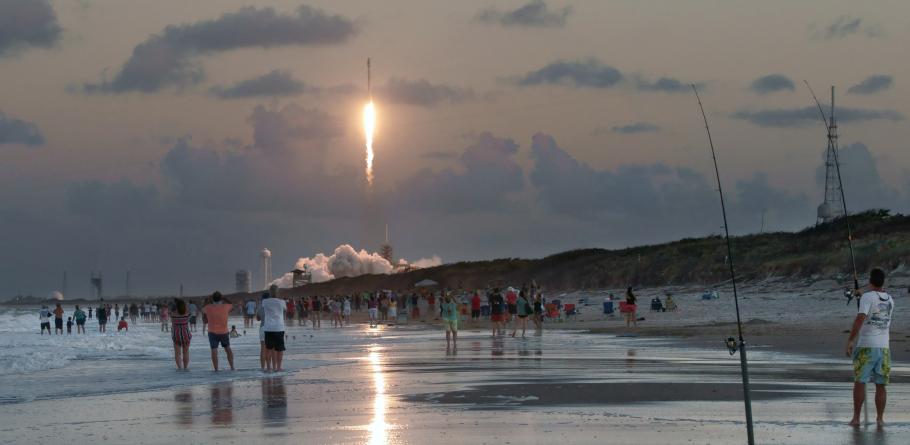
Rocket launch at Playalinda Beach, Florida, 2017. Picture by Jill Bazeley
People’s daily lives have always relied heavily on their link with outer space. From using the constellations for navigation millennia ago to connecting with thousands of satellites that provide geopositioning, communication, and weather monitoring services, outer space has been a constant companion. But it doesn’t always appear as such in today’s world. Today, space exploration might seem distant and reserved for a select few—astronauts, billionaire tourists, astronomers, or the military. However, ethnographic work shows how deeply outer space is intertwined with people’s lives on Earth, from the daily work of space scientists to the impacts of space infrastructure on local communities around the world.
Since outer space cannot often be known directly, what humans know about it and how they relate to it tends to be shaped by what they know about and how they relate to Earth. Consequently, earthly relations and political dynamics inevitably influence human activities in space. At the same time, an anthropological perspective on outer space can help defamiliarise the taken-for-granted contexts and factors specific to the earthly realm, revealing how deeply they shape human lives and people’s understanding of Earth within the cosmos. Thus, examining outer space can help us recontextualise fundamental questions about society and culture, compelling us to expand our analytical framework to encompass the cosmic realm but also encouraging us to explore alternative models for social life on Earth and beyond. This entry showcases anthropological research that has attempted to answer three fundamental questions at the human-cosmos interface: How do people interact with outer space? How does outer space impact human lives? How does outer space influence our understanding of social reality?
Introduction
Outer space exerts a constant, albeit sometimes imperceptible or remote, influence on the daily lives of people worldwide. From treating the sky as the domain of ancestors and a guide for social and environmental understanding, to utilising space-based infrastructures and technologies for essential needs like communication and travel, outer space profoundly impacts human existence. Yet, what constitutes ‘outer space’? How have people interacted with this realm? And given its intimate connection to human life, is the term ‘outer’ space even appropriate?
The boundary between Earth’s atmosphere and outer space remains ambiguous, conventionally placed between 80 and 100 kilometres above sea level. Anthropological studies generally avoid rigid definitions of outer space as a purely physical entity, recognising it instead as a domain of human sociality beyond Earth’s atmosphere where diverse political, social, economic, and cultural relations are being played out.
At the same time, media and political discourses often frame outer space within an expansionist, competitive, and developmental narrative, employing terms like ‘space colonisation’, ‘frontier’, ‘race’, and ‘settlement’. Some of these are also used in academic literature. International and national legislation governing space activities, such as the UN Outer Space Treaty of 1967 and the US Commercial Space Launch Competitiveness Act of 2015, frequently reinforce the perception of space as an empty territory, available on a first-come, first-served basis. Some argue that the very descriptors ‘outer’ and ‘extraterrestrial’ perpetuate this sense of detachment, overlooking the long-standing Indigenous connections to the sky and the myriad ways in which it has shaped the lives of various communities and individuals throughout history, both before and after rockets soared through the atmosphere (see, for example, Bawaka Country et al. 2020). Certain critical scholars refer to outer space with the term ‘cosmos’, which usually carries a more philosophical or spiritual connotation than ‘outer space’. Within this entry, these terms are treated as synonymous. Doing so deliberately avoids reinforcing some of the dualisms—such as technology/culture or sacred/profane—that anthropological inquiry strives to critically examine and challenge.
Space anthropology is still an emerging field, despite its roots in early works by Ben Finney and Eric Jones (1986), among others. While it is already grappling with intricate terminological challenges and shifting research foci, its inquiries are fundamentally driven by a desire to ask better questions about humans and understand their place within the cosmos. Thus, ethnographic studies have investigated communities deeply immersed in outer space, such as space scientists discovering new planets by comparing their features to Earth and engineers working with Martian rovers that navigate an extraterrestrial terrain, for whom the cosmos is not merely an imagined realm but also a remote yet tangible and real place. These studies demonstrate that our understanding of the cosmos is not solely derived from an unmediated scientific perception, but rather shaped by a confluence of individual imaginations, organisational structures, and national cultural influences (Messeri 2016; Vertesi 2015).
As people’s familiarity with the vast cosmos deepens, it forces them to re-evaluate Earth’s position within it, broadening understandings of human environments and challenging anthropocentric and geocentric perspectives. At the same time, anthropological and historical research consistently underscores the persistent terrestrial impacts of space exploration, the ecological and social footprint of which extends beyond the celestial sphere. Launch sites, research facilities, and other infrastructure are firmly rooted on Earth. These structures are not merely stepping stones to the cosmos; anthropological research argues that they are also intricately intertwined with earthly realities of colonialism, environmental impacts, and social displacement (e.g. Redfield 2000, 212–44). Outer space thus emerges as an arena of political power struggles, military competition, and capitalist expansion, where approaches deemed historically problematic on Earth are apparently readily adopted for exploring the unknown. Despite the powerful forces that frame the cosmos as a domain for profit-making and geopolitical expansion, anthropological perspectives both provide nuance for and problematise these narratives.
As space exploration continues, anthropological analysis has also addressed the more speculative possibilities of encountering extraterrestrial cultures or establishing human habitats beyond Earth. Ethnographic knowledge of intercultural dialogue, encounters, and migrations once served as anthropologists’ claim to a rightful role in space exploration endeavours (Finney and Jones 1986). Today, some continue to envisage outer space as a potential new home for humanity where the limitations and shortcomings of current societies could be transcended (Valentine 2012). This opens up discussions about human futures, both on Earth and potentially beyond. Consequently, outer space emerges as a space for not only critiquing existing politico-economic relations but also for projecting and contemplating alternative social formations.
From an anthropological perspective, outer space can, on the one hand, be understood as an extension of terrestrial realities. According to this approach, earthly relationships and dynamics play out and expand within a cosmic context, intricately connected to events on Earth. On the other hand, outer space can also be seen as an overarching realm that encompasses our planet. This perspective recontextualises Earth’s position and significance within the cosmos. It offers potential avenues for imagining alternative social and economic relations both on Earth and beyond. This entry delves into anthropological investigations exploring the profound relationship between humans and outer space. It examines three core questions that have shaped space anthropology so far. These are: How do humans engage with the cosmos? What is the impact of outer space on our lives? And what is its influence on people’s understanding of social reality?
How do people interact with outer space?
Ethnographic research has demonstrated a diverse range of ways in which people around the world engage with the cosmos. Their interactions shape their understanding of its significance within their communities and for humanity as a whole. While these understandings may sometimes differ, their analytical value lies in their capacity to offer alternative perspectives that can enrich, nuance, problematise, or challenge established narratives of space and space exploration. For example, Indigenous connections with the sky often problematise the assumption that outer space is empty and inanimate and no people or beings other than a limited number of astronauts have travelled or lived in space. Reportedly, Inuit peoples in Alaska laughed when an anthropologist informed them about the first Moon landing, as they claimed to have been travelling there for years (Young 1987).
In fact, several Indigenous knowledges express a profound interconnectedness between the earthly and cosmic realms, recognising their mutual dependence. The sky is often considered to be inhabited by ancestors and other beings. Indigenous cosmologies such as those of the Yolŋu in northern Australia are deeply embedded within the stories told about outer space and the sky (Bawaka Country et al. 2020). Moreover, oral traditions and Indigenous knowledge of the skies not only aid in understanding natural patterns related to weather, seasons, animal behaviour, and plant life but also sometimes pre-date Western scientific knowledge of historical celestial phenomena (Hamacher 2023). Given their close and kin relationships with the cosmos, Indigenous communities worldwide such as the Diné (the Navajo nation in the southwestern United States) often caution against exploitative approaches to space exploration, which they believe disrupt the cosmic order (Bartels 2024).
Non-Indigenous interactions with the cosmos can appear to lack the Indigenous sense of kinship with the sky. Space scientists and engineers within major Western space agencies and laboratories, recently the focus of ethnographic attention, often rely on technological devices and terrestrial landscapes to mediate their interactions with and conceptions of the cosmos. However, even they strive to reaffirm the reality of the cosmic objects they study and operate upon, seeking to establish more intimate and multi-layered relationships with outer space.
For instance, scientists who study planets that circle stars outside our solar system (exoplanets) strive to measure the dimming of a star while the exoplanet transits across its face—a technique known as ‘the transit method’. Subsequently, they visualise and interpret data obtained through such methods to turn the measurements into something that would seem more tangible and relatable. As part of this process, the scientists imagine exoplanets as potential places that they might inhabit, as worlds (Messeri 2016). They draw, for example, upon the more familiar language of the Earth’s solar system to describe the properties of newly discovered planets. Even though their precise parameters remain uncertain, astronomers employ familiar comparisons, calling the exoplanets ‘super-Earths’ or ‘hot Neptunes’, etc. They also utilise a variety of visualisation techniques, from producing curves and graphs to generating statistics, to represent these places that elude visual observation. Similarly, scientists can now translate cosmic phenomena, such as gravitational waves, into audible sounds. While this process relies on established scientific theories, models, and instrumental captures, the resulting sounds are also shaped by a multitude of social and cultural metaphors. For example, an astronomical observatory is compared to ‘a hearing aid’ and sounds of cosmic phenomena to ‘chirps’ or ‘whines’. These visual and acoustic ‘informalisms’ (Helmreich 2016) not only reflect upon the original theories and instrumental data but also foster a more intimate connection between the astronomer and the celestial objects they study.
This connection mirrors the direct experience of observing the night sky at an optical observatory. Although astronomical work increasingly relies on digital data, some astronomers still deeply value the opportunity to conduct research at an observatory, where the distant universe becomes more tangible (Hoeppe 2012). Ethnographic work within science and engineering teams responsible for operating Mars rovers has also underscored the importance of such embodied practices (Vertesi 2015). Various team members identified with the bodies of the rovers, incorporating their physical gestures and movements into their understanding of the rovers and their objects of analysis. This shows how important representational techniques are in establishing and cultivating relationships with the extraterrestrial. Simultaneously, team members aligned their work structures with local and workplace-based norms, meetings, and forms of talk, thereby forging a specific community. Put differently, the intimate engagements with the Mars rovers represented the extraterrestrial as well as contributing to the production and maintenance of a particular social order. People’s representations of and engagements with outer space not only facilitate the scientific exploration of the cosmos and render extraterrestrial scientific objects more legible, but also generate new social relations on Earth, aligning individuals’ aims and values in their collective endeavour to familiarise the unknown.
Many of the techniques that bring the cosmos closer and render it more familiar are inherently social and cultural. Consequently, our representations of outer space are profoundly shaped by cultural tropes and socio-political narratives. The spectacular images captured by the Hubble Space Telescope, for example, are not merely unfiltered photographs of the universe; they are products of scientific and aesthetic negotiation. Astronomers had to make deliberate choices about how to translate raw data into meaningful colours and contrasts. In the process, they drew upon familiar geological and meteorological formations, as well as the iconography of nineteenth century American Western landscapes (Kessler 2012). These images were carefully composed for both American domestic and international audiences, serving as a form of scientific outreach and public service. However, by drawing parallels to earthly landscapes and aligning with narratives of outer space as a frontier, these images also encouraged a specific perception of the cosmos: a place simultaneously distant yet inviting exploration. Similar dynamics are evident in other public-facing initiatives, even those designed to be more ‘democratic’, i.e. open to independent public interpretation. For instance, a group of computer scientists at NASA aimed to create an interactive map of Mars that the public could explore independently. Yet, even this initiative promoted a specific way of seeing Mars: as a dynamic, vital place that merits continued research and financial commitment from NASA's exploration project—ultimately reflecting NASA’s overarching mission of extraterrestrial conquest (Messeri 2017). Our highly mediated engagements with outer space offer valuable insights into the socio-cultural nature of how humans represent the cosmos. They also demonstrate how we connect to the cosmic realm while simultaneously shaping our realities on Earth.
Analogue sites (and various forms of simulation training, more generally) offer another example of an important medium for human interaction with outer space, particularly for experimenting with aspects of human spaceflight missions. These sites allow space scientists and future astronauts to familiarise themselves with the unfamiliar environment of outer space while remaining on Earth. Analogue research typically involves travelling to locations with environmental, geological, or other conditions resembling those found on Mars or other celestial bodies, enabling the testing of equipment and mission designs. For example, ethnographic work with scientists at NASA demonstrates how Mars was brought into being as a group of scientists descended upon an analogue site in the Utah desert (Messeri 2016). These ‘mission’ members treated earthly geological formations as if they were Martian, weaving planet-specific narratives about their past and present. This experience provided the closest possible approximation of being on Mars, and it helped maintain the possibility of future human habitation on the planet. The physical and imaginary elements of the analogue mission, including the strict protocols governing ventures outside the ‘space habitat’, induced a cognitive shift among its participants, redefining the experience of living on Earth. However, these missions also possessed more practical elements. At the time of this research, NASA had stalled plans for human missions to Mars. Consequently, the activities observed by the anthropologist present also represented an attempt by NASA employees to cultivate a utopian narrative within the agency, one that preserved the possibility of Martian missions in the future (Messeri 2016).
In another ethnographic study of analogue sites, anthropologist Valentina Marcheselli worked with astrobiologists in Italian caves and mines, simulating potential microbial habitats or shelters on Mars (2022). Their embodied experiences of the caves and mines were crucial not only for transforming these earthly settings into otherworldly analogues but also for establishing astrobiology as a novel scientific discipline. The analogue astrobiological work challenged traditional scientific practices, as its observations and results were no longer solely derived from hypothesis testing but emerged through a more open-ended approach. Such embodied and open-ended research was deemed particularly suitable for a discipline dedicated to encountering and explaining the extraterrestrial unknown. Studying analogue sites, then, reveals something about the inherently dual nature of analogue space missions. In trying to keep Martian exploration viable in times of institutional contraction, or reinforcing the case for a new scientific research method, they aim to make mission participants more intimately familiar with another world, while also utilising this work to influence human engagement with this one.
In a similar vein, astronautics, or the science of space travel, is thought of by US scientists, physicians, and engineers involved in human spaceflight as relying on various ‘systems’ in order to work (Olson 2018). Such systems are defined as technologies that relate diverse concepts and materialities to one another. Thinking of human-technology constellations as systems serves a technocratic function. It contributes to perceiving outer space as governable, thereby perpetuating expansionist narratives of space exploration. The work conducted in extreme terrestrial environments, such as analogue lunar bases on the seafloor, and the allure of radically different extraterrestrial conditions, resonates with a culture in which the extreme has positive connotations as a catalyst for improvement and progress. Consequently, analogue missions participate in a cultural dynamic that frames the extreme as an imperative for overcoming challenges, fostering social innovation, and achieving distinctiveness (Olson 2018).
Earlier research on the European Space Agency (ESA) examined the entanglement of space with a different cultural dynamic, specifically the metaphor of European cooperation (Zabusky 1995). Studied during the 1990s, European cooperation in space science turned out to, paradoxically, rely on both conflict and diversity. The inherent internal diversity of European institutions, in which staff comes from different cultures and linguistic backgrounds, helps ESA employees avoid feelings of alienation and stagnation. Through regular, contested interactions and performances of difference, cooperation emerges through space technology as a form of rational solidarity. However, this process is not merely instrumental; it also constitutes a journey through which individuals experience a sacred and intense sense of community (i.e. communitas).
Even though science often claims to be largely impartial and independent of cultural influences, the social nature of the human-space interface is evident not only within the structures and practices of scientific communities, but also in the scientific outcomes of major research organisations such as NASA. Their varied internal hierarchies and interactional norms produce different kinds of scientific knowledge. Sometimes NASA's collective work modes relied on collectivist decision-making structures such as consensus, and emphasised the importance of arriving at a common ground. On other occasions, integrative work modes were favoured, stemming from a position that respected the autonomy of separate units and tried to unite the particular interests of different units in some form of a workable whole. These differing organisational structures were reflected, for example, in the authorship structure of scientific articles and in the influence that different scientific disciplines had in NASA's research (Vertesi 2020).
While the socio-cultural connections between Earth and outer space turn out to be robust, as is evident in human representations and engagements with the cosmos, it is also crucial to avoid an overly deterministic view of this relationship. While human perceptions and interactions with the universe are undoubtedly shaped by cultural narratives and social structures, these influences are multifaceted and nuanced rather than one-dimensional or all-powerful. For example, NASA employees working with Mars rovers encountered significant challenges in aligning their work schedules with the Martian day-night cycle, which is around 40 minutes longer than that of Earth. Despite the use of visual displays and other representational techniques to track Martian time, the inherent mismatch between Earth and Mars time led to confusion and—with ever-changing work schedules meant to allow staff to keep up with Mars—bodily fatigue (Mirmalek 2020). This highlights the limitations of simply imposing external (and extraterrestrial) frameworks on human experience.
Just as the human body cannot simply adapt to Martian time while remaining firmly rooted on Earth, human imaginations are not solely shaped by dominant narratives of space exploration. Ethnographic work with 'New Space' advocates, who invest in commercial space ventures (Valentine 2012), as well as space creators and enthusiasts, who popularise space exploration (Szolucha 2024), reveals a more nuanced picture. While these individuals may operate within the constraints of capitalist relations or navigate the uncertainties of a social spectacle, they also challenge conventional investment strategies, foster community, and actively produce shared visions of the future, thereby creating new social relations. The work of space creators, for example, not only popularises space exploration and makes it comprehensible to a global audience of enthusiasts, but also has the power to mould the public’s collective space myths. The collective imagination of outer space may, therefore, contain possibilities for new narratives of space exploration.
How does outer space impact human lives?
Space exploration leaves a visible mark on Earth, requiring diverse infrastructure for the manufacture and operation of space technologies. These facilities are often situated in locations perceived as remote or uninhabited. However, anthropological research foregrounds the stories of communities impacted by these developments, emphasising their needs, perspectives, and the structural biases that limit their agency. For example, several engaged anthropologists worked during the 1970s with the Yanadi, an Indigenous tribe in India with a nomadic lifestyle historically centred around hunting and gathering (Agrawal, Rao and Reddy 1985). This engagement occurred shortly after the Indian Space Research Organisation (ISRO) had acquired the Yanadi’s traditional lands to establish a new space centre on an island off India’s eastern coast. The anthropologists documented the profound changes ISRO brought to the region, displacing the Yanadi from their traditional hunting grounds, offering employment opportunities, and creating new community facilities. By collaborating with the Yanadi and ISRO, the anthropologists helped negotiate extended land access rights for the tribe members and educated the ISRO about the social impacts of its activities on the Yanadi community.
The Yanadi case is not an isolated historical incident. Displacement or various degrees of neglect of Indigenous or disadvantaged populations during state or commercial encroachment on their territories has been a recurring theme in the construction and siting of space-related infrastructure, persisting to the present. In the 1980s, the space base in northeastern Brazil displaced Afro-Brazilian villagers, reflecting a history of class and racial inequality within the country (Mitchell 2017). In French Guiana, the construction and operation of ESA’s spaceport in Kourou continues to be entangled with the colonial history of the region (Redfield 2000) and its peculiar status as a European periphery (Korpershoek 2024). Currently, the Native American Esto’k Gna oppose the operations of a private space company for restricting the access to their traditional lands on the southern tip of Texas in the United States (Szolucha 2023). The proposed construction of the Thirty Meter Telescope on the sacred mountain of Maunakea in Hawai'i, despite sustained local protest and predicted environmental impacts, is another example (Hobart 2019; Maile 2019). Anthropologists have helped to amplify the experiences and perspectives of Indigenous and disadvantaged groups, documenting the historical legacies of inequality and injustice, while exploring potential avenues for change.
Such examples have led some social scientists to formulate more sweeping critiques of space exploration efforts, characterising them as inherently colonial and exploitative (for example, Rubenstein 2022; Treviño 2023). Against such views, critical scholars propose alternative approaches to engaging with the cosmos, such as celestial wayfinding. Aiming to mirror the way Polynesians navigated the ocean and to avoid the perpetuation of colonial dynamics in space exploration, celestial wayfinding is meant to be guided by principles of sustainable settlement, informed by an animate view of the cosmos and based on a belief in the inherent value and necessary co-existence of all beings (Lempert 2021). The !Kung San people of the Kalahari Desert in southern Africa have been suggested as a positive and egalitarian model for social organisation of space communities (Lee 1985). Their adaptations were based on the practice of sharing, living in a small group, and being self-sufficient for a very long time. Anthropologists have also considered the Minangkabau people of West Sumatra, with their emphasis on mutual learning and reciprocal interaction, as a potential model for interstellar migration (Tanner 1985). Furthermore, alternative modes of travelling and living together that have been explored in science fiction movies also hold the potential to inspire and improve space exploration (Lempert 2014; Salazar 2023).
Queer and feminist perspectives on space exploration equally offer frameworks for reimagining it. ‘Queering the cosmos’ would involve liberating it from the constraints of established, often limited, visions of the future and opening it up to multiple possibilities (Oman-Reagan 2015). Similarly, feminist approaches to space travel challenge the presumption of heterosexuality—pervasive within the imaginaries and designs of human spaceflight—and critically examine the ideological and structural biases that lead to exclusionary and oppressive practices and imaginaries (Gál and Armstrong 2023).
While various critical approaches are being proposed to ‘reclaim outer space’ (Schwartz, Billings and Nesvold 2023) a growing body of anthropological work is emerging in parallel that challenges the seemingly monolithic character of modern space projects. On the one hand, space infrastructure developments are typically justified in the name of scientific and economic advancement for a specific community, region, or even nation. While the examples above illustrate some significant challenges and pitfalls of these justifications, space projects may mobilise a sense of hope, agency, and visions of alternative futures that extend beyond serving as an escape plan for a select few (Denning 2023). They can provide alternative visions of international cooperation and even increased ecological care.
At the same time, outer space has always held the potential for increased militarisation, neocolonialism, and extractivism. Anthropologists demonstrate that these two facets, of care and extractivism, are inextricably linked and that space exploration, while perpetuating harmful legacies, also automatically elicits alternative practices and visions of the future (see, for example, Ojani 2024). Many Mexicans, for example, reveal complex imaginaries surrounding space. They see space exploration as a pathway to economic development through technological innovation while simultaneously emphasising the need to critically reflect on the conditions that shape its achievement (Johnson 2020). Similarly, astronomers in Madagascar demonstrate that a problematic and culturally specific notion of the ‘universality of science’ can nevertheless serve as a tool for navigating inequalities on Earth (Nieber 2024). Assuming that science is to some extent universal is not just an epistemic requirement for gaining entry into an international scientific network. It is also a horizon of possibility, one that offers both hope and direction.
How does outer space influence our understanding of social reality?
Outer space not only affects people’s lives but also recalibrates their structures of understanding. Being outside Earth and thinking about the cosmos involves encountering extraterrestrial materialities and contexts that are unfamiliar or behave in unexpected ways. Living in microgravity on the International Space Station (ISS), for example, removes the people involved from the familiar bounds of Earth and from usual ways of being and feeling human. The physical experience of weightlessness affects emotions and their social expression, demonstrating how gravity—a condition we typically take for granted—influences not only the human body but also emotions and social relations. This is because the effective communication of emotions and human relations depends on certain material conditions. When those are dramatically altered in such environments as outer space, a simple hug, for example, becomes a challenge because bodies behave and react differently than they would on Earth. The hug becomes a somewhat awkward experience, because bodies of astronauts struggle to align and exchange the same sense of touch they would under the conditions of gravity (Parkhurst and Jeevendrampillai 2020). Similarly, venturing beyond Earth’s atmosphere allows us to reconsider its role as a primary context, one that provides the reference points for our fundamental understandings and distinctions, such as the one between nature and culture, for example (Battaglia 2012; Valentine 2016). An anthropological engagement with outer space turns out to broaden the notions of what constitutes an ‘environment’ and to decentre our geocentric and anthropocentric perspectives (Battaglia, Valentine and Olson 2015; Helmreich 2012; Olson and Messeri 2015).
This recalibrating nature of outer space has also prompted a rethinking of anthropological methodologies (see, for example, Gorbanenko, Jeevendrampillai and Kozel 2025). Specifically, it has been suggested that anthropological research be recontextualised in ‘more-than-terran’ spaces (Olson 2023), to think about fieldwork as having significance and being localised beyond Earth, and as being entangled with entities, dynamics, and phenomena beyond Earth-based contexts. While humans’ earthly embeddedness is undeniable, an expanded methodological toolkit would acknowledge that societies already exist on a boundary between terrestrial and extraterrestrial realms. However, how radically methodologies need to be adjusted is currently somewhat under dispute. Given that people constantly negotiate their social existence through a dialogue with their social and material worlds, life on Earth may be quite mediated already and therefore not that different to study than life in space (Jeevendrampillai et al. 2023).
Ethnographic research in locations like the ISS is unlikely to occur anytime soon, given how expensive and hard it is to access. Studying Earth-based space infrastructures related to it, such as its Mission Controls, is much more feasible and can still be highly elucidating. Ethnographers can more easily enter a meeting in ground-based buildings by government agencies and companies designing space experiments or observe livestreamed conversations with ISS crews. Seemingly remote locations can thus be studied via the multiple, interconnected sites, media, and groups of people that constitute a field both up in space and here on Earth (Buchli 2020). These include the constant online presence of the ISS, multimedia archives, and communities tracking the ISS from Earth.
Space activities, both on Earth and in outer space, are dispersed across vast distances and dynamically evolving networks. Therefore, field sites are never stable entities but are better understood as sometimes-atomised and relational spaces connected through shared meanings and materialities (Timko 2024). The distributed nature of space-related sites and globally dispersed communities has led to the idea of a ‘planetary ethnography’ (Szolucha et al. 2022; 2023). This approach to research seeks to push the boundaries of representation to uncover new perspectives both by engaging with diverse social groups across different cultures and by bringing them into a comparative analysis that can reveal unexpected alliances or effect a change in perspective. These under- or unrepresented experiences and viewpoints, much like the extraterrestrial itself, should have the potential to revisit and reorient entire fields of understanding, rather than simply adding another perspective, one that remains on the periphery.
Conclusion
Although outer space remains a physically distant horizon, unreachable for most, it is closer than one may think. It plays a significant role in the everyday lives of diverse groups, from Indigenous communities to the global network of space professionals. Through their engagement with outer space and its many representations, they make communal histories, social norms, as well as distant celestial objects and phenomena more readily comprehensible. In doing so, they reshape social relations and realities here on Earth. Regardless of how they connect with the sky, people worldwide seem to actively strive to forge more intimate relationships with the cosmos, underscoring its inextricable link to human life.
But why is this connection with the universe so important? Perhaps the answer lies in viewing outer space as a social and cultural canvas, one on which individuals and communities can project their understanding of the present social order and their aspirations for the future. For example, Russian cosmonautic amateurs who build and test satellites and other space technologies hold the idea that anyone can participate in space exploration, even without government backing (Sivkov 2019). Their activities highlight the importance of merit and technological know-how in driving space exploration. Therefore, engaging with the cosmos allows them to critique the social and political realities of their country. Outer space can thus be understood as a field for critiquing current social conditions and experimenting with potential alternatives.
Popular representations of extraterrestrial life and unidentified flying objects (‘UFOs’) have also been interpreted as expressions of broader socio-political concerns. These include feelings of alienation and mistrust towards political representatives. Alien abduction narratives equally reflect anxieties, including concerns about racial and ethnic difference. In other depictions, extraterrestrial beings are viewed as divine, expanding the scope of human understanding beyond purely scientific explanations. Historically, ‘ufology’—the study of UFOs—emerged from anxieties surrounding military tensions and technological advancements (Battaglia 2006), a dynamic that continues to resonate today.
Public interest in the cosmos waxes and wanes, driven by the vagaries of politics and cultural trends while popular sentiment toward even the most successful space programmes is often ambiguous (Launius 2003). However, anthropological research has definitively demonstrated that people worldwide actively seek deeper and more complex connections with the cosmos. It is an inextricable part of daily life, shaping their past, co-creating their present, and prefiguring their future.
This understanding challenges the detached view of the cosmos as an outside domain, a perspective some argue was reinforced by the first images of Earth taken by astronauts of Apollo missions from the void of space (Arendt 1968; Cosgrove 1994). This seemingly detached ‘view from nowhere’ may perpetuate the notion that the cosmos is simply there for the taking, whether by technologically advanced nations or an oligarchy-controlled private sector. If technological engagement with outer space expands in the coming decades, largely fuelled by commercial and military-led space ventures, what convergences and tensions will emerge with the fundamental human drive for cosmic intimacy? One thing is certain: humanity will discover ever-new ways to imbue outer space with meaning, both on Earth and beyond.
References
Agrawal, Binod C., N. Sudhakar Rao, and P. C. Gurivi Reddy. 1985. Yanadi response to change: An attempt in action anthropology. New Delhi: Concept.
Arendt, Hannah. 1968. Between past and future: Eight exercises in political thought. New York: Viking Press.
Bartels, Meghan. 2024. "Human remains are headed to the moon despite objections." Scientific American, 5 January. https://www.scientificamerican.com/article/human-remains-are-headed-to-t....
Battaglia, Debbora, ed. 2006. E.T. culture: Anthropology in outerspaces. Durham, N.C.: Duke University Press.
———. 2012. "Coming in at an unusual angle: Exo-surprise and the fieldworking cosmonaut." Anthropological Quarterly 85, no. 4: 1089–106. https://doi.org/10.1353/anq.2012.0058.
Battaglia, Debbora, David Valentine, and Valerie Olson. 2015. "Relational space: An earthly installation." Cultural Anthropology 30, no. 2: 245–56. https://doi.org/10.14506/ca30.2.07.
Bawaka Country, A. Mitchell, S. Wright, S. Suchet-Pearson et al. 2020. ‘Dukarr lakarama: Listening to Guwak, talking back to space colonization." Political Geography 81: 102218. https://doi.org/10.1016/j.polgeo.2020.102218.
Buchli, Victor. 2020. "Extraterrestrial methods: Towards an ethnography of the ISS." In Lineages and advancements in material culture studies, edited by Timothy Carroll, Antonia Walford, and Shireen Walton, 17–32. London: Routledge.
Cosgrove, Denis. 1994. "Contested global visions: One-world, Whole-earth, and the Apollo space photographs." Annals of the Association of American Geographers 84, no. 2: 270–94. https://doi.org/10.1111/j.1467-8306.1994.tb01738.x.
Denning, Kathryn. 2023. "Reclaiming space: On hope in a jar, a Bear in the Sky, and the Running Red Queen." In Reclaiming space: Progressive and multicultural visions of space exploration, edited by James S.J. Schwartz, Linda Billings, and Erika Nesvold, 196–212. Oxford: Oxford University Press.
Finney, Ben R., and Eric M. Jones, eds. 1986. Interstellar migration and the human experience. Berkeley: University of California Press.
Gál, Réka Patrícia, and Eleanor Armstrong. 2023. "Feminist approaches to outer space: Engagements with technology, labour, and environment’. In The Routledge handbook of social studies of outer space, edited by Juan Francisco Salazar and Alice Gorman, 158–71. London: Routledge.
Gorbanenko, Jenia, David Jeevendrampillai, and Adryon Kozel, eds. 2025. Exploring ethnography of outer space: Methods and perspectives. New York: Routledge.
Hamacher, Duane. 2023. The first astronomers: How Indigenous elders read the stars. Crows Nest: Allen & Unwin.
Helmreich, Stefan. 2012. "Extraterrestrial relativism." Anthropological Quarterly 85, no. 4: 1125–39.
———. 2016. "Gravity’s reverb: Listening to space-time, or articulating the sounds of gravitational-wave detection’. Cultural Anthropology 31, no. 4: 464–92. https://doi.org/10.14506/ca31.4.02.
Hobart, Hi’ilei Julia. 2019. "At home on the Mauna: Ecological violence and fantasies of terra nullius on Maunakea’s summit." Native American and Indigenous Studies 6, no. 2: 30–50.
Hoeppe, Götz. 2012. "Astronomers at the observatory: Place, visual practice, traces." Anthropological Quarterly 85, no. 4: 1141–60.
Jeevendrampillai, David, Victor Buchli, Aaron Parkhurst, Adryon Kozel, Giles Bunch, Jenia Gorbanenko, and Makar Tereshin. 2023. "An ethnography of an extra-terrestrial society: The International Space Station." In The Routledge handbook of social studies of outer space, edited by Juan Francisco Salazar and Alice Gorman, 413–26. London: Routledge.
Johnson, Anne Warren. 2020. "A Mexican conquest of space? Cosmopolitanism, cosmopolitics, and cosmopoetics in the Mexican space industry." Review of International American Studies 13, no. 2: 123–44. https://doi.org/10.31261/rias.9808.
Kessler, Elizabeth A. 2012. Picturing the cosmos: Hubble Space Telescope images and the astronomical sublime. Minneapolis: University of Minnesota Press.
Korpershoek, Karlijn. "A tale of two outers: Studying up, down and around Europe’s Ville Spatiale in South America." PhD dissertation, Jagiellonian University, Kraków, 2024.
Launius, Roger D. 2003. "Public opinion polls and perceptions of US human spaceflight." Space Policy 19, no. 3: 163–75. https://doi.org/10.1016/S0265-9646(03)00039-0.
Lee, Richard B. 1985. "Models of human colonization: !Kung San, Greeks, and Vikings." In Interstellar migration and the human experience, edited by Ben R. Finney and Eric M. Jones, 180–94. Berkeley: University of California Press.
Lempert, William. 2014. "Decolonizing encounters of the third kind: Alternative futuring in Native science fiction film." Visual Anthropology Review 30, no. 2: 164–76. https://doi.org/10.1111/var.12046.
———. 2021. "From interstellar imperialism to celestial wayfinding: Prime directives and colonial time-knots in SETI." American Indian Culture and Research Journal 45, no. 1: 45–70. https://doi.org/10.17953/aicrj.45.1.lempert.
Maile, Uahikea. 2019. "Resurgent refusals: Protecting Mauna a Wākea and Kanaka Maoli decolonization." Hūlili: Multidisciplinary Research on Hawaiian Well-Being 11, no. 1: 57-69. https://www.academia.edu/40930104/Resurgent_Refusals_Protecting_Mauna_a_....
Marcheselli, Valentina. 2022. "The exploration of the Earth subsurface as a Martian analogue’."TECNOSCIENZA: Italian Journal of Science & Technology Studies 13, no. 1: 25–46.
Messeri, Lisa. 2016. Placing outer space: An earthly ethnography of other worlds. Durham, N.C: Duke University Press.
———. 2017. "Extra-terra incognita: Martian maps in the digital age." Social Studies of Science 47, no. 1: 75–94. https://doi.org/10.1177/0306312716656820.
Mirmalek, Zara. 2020. Making time on Mars. Cambridge, Mass.: MIT Press.
Mitchell, Sean T. 2017. Constellations of inequality: Space, race, and utopia in Brazil. Chicago: Chicago University Press.
Nieber, Hanna. 2024. "Universality as horizon: Aspirations and geometries of astrophysics in Africa." Zeitschrift Für Ethnologie/Journal of Social and Cultural Anthropology 149, no. 1: 53–70. https://doi.org/10.60827/zfe/jsca.v149i1.1877.
Ojani, Chakad. 2024. "Reindeer, rockets and space infrastructures: Enacting oligoptic-satellitarian environments in Northern Sweden." Environment and Planning E: Nature and Space 7, no. 6: 1957–74. https://doi.org/10.1177/25148486241262621.
Olson, Valerie. 2018. Into the extreme: U.S. environmental systems and politics beyond Earth. Minneapolis: University Of Minnesota Press.
———. 2023. "Refielding in more-than-terran spaces." In The Routledge handbook of social studies of outer space, edited by Juan Francisco Salazar and Alice Gorman, 31–43. London: Routledge.
Olson, Valerie, and Lisa Messeri. 2015. "Beyond the Anthropocene: Un-earthing an epoch." Environment and Society 6, no. 1: 28–47. https://doi.org/10.3167/ares.2015.060103.
Oman-Reagan, Michael. 2015. "Queering outer space." Space + Anthropology, September 11. https://medium.com/space-anthropology/queering-outer-space-f6f5b5cecda0.
Parkhurst, Aaron, and David Jeevendrampillai. 2020. "Towards an anthropology of gravity: Emotion and embodiment in microgravity environments." Emotion, Space and Society 35(2): 100680. https://doi.org/10.1016/j.emospa.2020.100680.
Redfield, Peter. 2000. Space in the tropics: From convicts to rockets in French Guiana. Berkeley: University of California Press.
Rubenstein, Mary-Jane. 2022. Astrotopia: The Dangerous Religion of the Corporate Space Race. The University of Chicago Press.
Salazar, Juan Francisco. 2023. "A chronopolitics of outer space: A poetics of tomorrowing." In The Routledge handbook of social studies of outer space, edited by Juan Francisco Salazar and Alice Gorman, 142–57. London: Routledge.
Schwartz, James SJ, Linda Billings, and Erika Nesvold, eds. 2023. Reclaiming space: Progressive and multicultural visions of space exploration. Oxford: Oxford University Press.
Sivkov, Denis Yu. 2019. "Space exploration at home: Amateur cosmonautics in contemporary Russia [Osvoenie Kosmosa v Domashnikh Usloviiakh: Liubitel’skaia Kosmonavtika v Sovremennoi Rossii]." Etnograficheskoe Obozrenie, no. 6: 67–79. https://doi.org/10.31857/S086954150007769-5.
Szolucha, Anna. 2023. "Planetary ethnography in a 'SpaceX village': History, borders, and the work of 'beyond'." In The Routledge handbook of social studies of outer space, edited by Juan Francisco Salazar and Alice Gorman, 71–83. London: Routledge.
———. 2024. "A disappearing frontier?: An ethnographic study of the labour of imagination of SpaceX fans and space creators in south Texas." Acta Astronautica 222: 87–94. https://doi.org/10.1016/j.actaastro.2024.06.001.
Szolucha, Anna, Karlijn Korpershoek, Chakad Ojani, and Peter Timko. 2022. "Planetary ethnography: A primer." SocArXiv, March 24. https://doi.org/10.31235/osf.io/sy2gh.
Szolucha, Anna, Peter Timko, Chakad Ojani, and Karlijn Korpershoek. 2023. "Ethnographic research of outer space: Challenges and opportunities." Ethnography (online): https://doi.org/10.1177/14661381231220273.
Tanner, Nancy Makepeace. 1985. "Interstellar migrations: The beginnings of familiar process in a new context." In Interstellar migration and the human experience, edited by Ben R. Finney and Eric M. Jones, 220–33. Berkeley: University of California Press.
Timko, Peter. "Plural presents and imagined futures of the new space economy." PhD dissertation, Jagiellonian University, Kraków, 2024.
Treviño, Natalie B. 2023. ‘Coloniality and the cosmos’. In The Routledge handbook of social studies of outer space, edited by Juan Francisco Salazar and Alice Gorman, 226–37. London: Routledge.
Valentine, David. 2012. "Exit strategy: Profit, cosmology, and the future of humans in space." Anthropological Quarterly 85, no. 4: 1045–67.
———. 2016. "Atmosphere: Context, detachment, and the view from above Earth." American Ethnologist 43, no. 3: 511–24. https://doi.org/10.1111/amet.12343.
Vertesi, Janet. 2015. Seeing like a Rover: How robots, teams, and images craft knowledge of Mars. Chicago: University of Chicago Press.
———. 2020. Shaping science: Organizations, decisions, and culture on Nasa’s teams. Chicago: University of Chicago Press.
Young, M. Jane. 1987. "'Pity the Indians of outer space': Native American views of the space program." Western Folklore 46, no. 4: 269. https://doi.org/10.2307/1499889.
Zabusky, Stacia E. 1995. Launching Europe: An ethnography of European cooperation in space science. Princeton, N.J: Princeton University Press.
Note on contributor
Anna Szolucha is an Associate Professor and Principal Investigator of the ARIES (Anthropological Research into the Imaginaries and Exploration of Space) project at the Institute of Ethnology and Cultural Anthropology, Jagiellonian University, Krakow, Poland. Her research interests lie at the intersection of new technologies, natural resources, and society.
Research for this article received funding from the National Science Centre, Poland, project number 2020/38/E/HS3/00241.
Anna Szolucha, Institute of Ethnology and Cultural Anthropology, Jagiellonian University, ul. Golebia 9, 31-007 Krakow, Poland. ORCID: 0000-0001-8938-6066