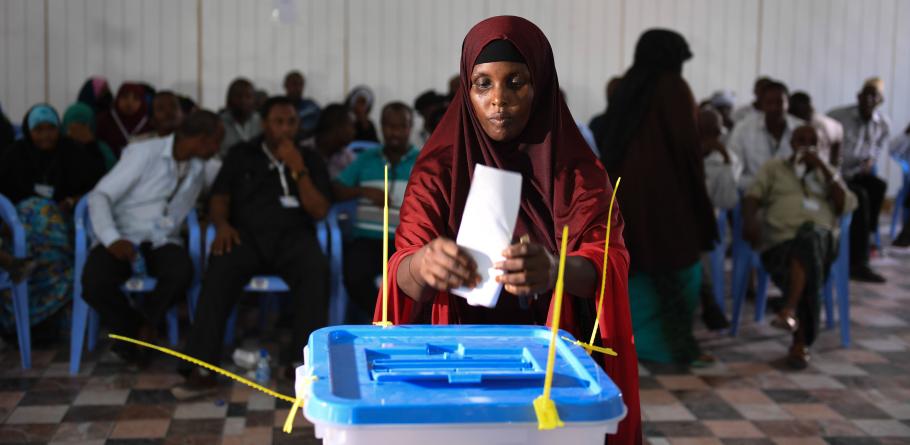
A delegate from Somaliland votes in Mogadishu, Somalia, on December 25, 2016. Photo by Ilyas Ahmed
Democracy is a system of governance and a value with a widespread presence worldwide. However, anthropological literature has shown that the transition to democracy articulates practices, institutions, and additional values that depend on previous political experience that is often locally specific. This results in distinct meanings of democracy, as people may not adhere to the principles of Euro-American democracy, which tends to be secular, liberal and representative. Ethnography has cast light on how kinship, religion, gender, morals, and the economy (among others) are entangled in people’s political allegiances and decisions and thereby shape democratic governmental actions. Anthropology focuses not only on who is defined as ‘the people’, and included or excluded from positions of power, but also on how power dynamics organise democratic values, practices, and institutions.
After conveying these established propositions on the anthropology of democracy, this entry will address three important discussions in the discipline: Firstly, it shows that two core Euro-American assumptions—that democracy is necessarily secular and liberal—are disputed worldwide, including in consolidated democracies, where religious movements and populist and authoritarian leaders are flourishing. Second, it discusses the configuration of citizenship, and the citizen’s active role in fighting for rights and in producing oneself as part of a moral collective. It highlights the power relations and political rationalities involved in these processes. The third section addresses the notion of being represented and of participating directly in a democratic government, by looking at the study of elections, the meanings attributed to voting, and at protests and social movements. The entry concludes by arguing that anthropologists’ particular contribution to the study of democracy is twofold: it highlights the cultural, social, and moral aspects in the everyday experiences of democracy among ordinary citizens; and it discovers unexpected power dynamics that shift not only what people fight for in a democracy but also how they do it.
Introduction
What ‘democracy’ is, or ought to be, is not easy to grasp. It is often identified with Euro-American and modern nation-states and seen as rooted in ancient Greek cities. Yet, definitions of democracy and the ideas associated with it have been the subject of extensive debate (Dunn 2019). A simple definition is that democracy corresponds to the ‘rule of the people’ (from the etymological basis of demos and kratia, literally meaning the ‘force of the people’). Modern and contemporary democracy is usually associated with a set of elements such as the rule of law, equality among its members, fair elections of representatives, and freedom of expression, to name only a few. Still, anthropological studies complicate these assumptions by discussing who counts as ‘the people’, how their political will comes to matter, and whether we should distinguish between democracy as ‘a form of governance (i.e. a mode of communal self-organization) or a form of government (i.e. one particular way of organizing a state apparatus)’ (Graeber 2007, 329). What is striking about democracy is that it has increasingly become a core value worldwide over the last one hundred years.
Anthropologists have been studying politics for a long time among people under colonial rule or otherwise dominated within a national context (e.g. Evans-Pritchard 1940; Gluckman 1940; Leach 1954). Hence, they were well-positioned to pay attention during fieldwork to transitions of societies recently liberated from colonial rule or dictatorships towards more democratic forms of governance. Since the 1970s, numerous countries around the world have transitioned to democratic regimes. In these contexts, anthropologists have shown that what democracy turns out to be in practice can be quite different from assumed universal understandings of it. In distinction to other disciplines, which focus on institution-building or the rule of law necessary for the fair election procedures among elites (cf. Mainwaring 1989), anthropological fieldwork has focused on concrete expectations for and lived experiences of democracy as well as the power dynamics at play, which in some cases prolonged the effects of previous political regimes or hindered desired political transformations. Ethnographic fieldwork also enables anthropologists to reject analyses which reinforce normative standards of what democracy should be, and which consider their understanding of democracy as an end goal for history and part of a single road to progress. Such normative analyses all too often continue a colonial mentality that defines non-Euro-American countries as perpetually backwards (Coronil 2019, 238-40).
Anthropological work also brings forth the points of view of local and ordinary people, instead of restricting the study of democracy to formal discourses and state institutions. Thereby, it casts light on how kinship, religion, morals, gender, and the economy (among others) are historically entangled in people’s political allegiances and decisions. Ethnographic research, for example, shows that democratic citizenship is not just a legal status but a form of belonging and behaving that is rooted in particular social experiences, and that people may manifest their interests and political demands in indirect and sometimes even hidden ways. Thus, anthropologists often study democracy in the same way as one would research other intimate domains, such as religion and kinship, allowing them to observe a ‘vernacularisation’ of democracy, i.e. an embedding and reshaping of democratic practices, in people's daily lives (Michelutti 2007).
For example, in northern India, the Yadavs, milk producers and members of a caste that claims ancestral ties to the Hindu god Krishna, draw upon this mythical-religious relationship to shape their political demands. They argue that democracy is a primordial phenomenon passed on from the blood of Krishna to contemporary Yadavs, and that they therefore deserve greater political influence (Michelutti 2007). Such discourse blends religion and governance in ways that contravene democracy’s purported separation between religion and state. Political support for the Yadav also reaches far beyond mere politics of interest or recognition, relying instead on links of caste, ethnicity, and kinship. It produces highly specific dynamics of political inclusion and exclusion, pitting for example Hindus and Muslims against one another, and it changes the meanings of voting from creating flimsy contractual relations to affirming existing ties of status, prestige, or power (Michelutti 2019, 204). The broader insight—that democracy articulates specific sets of practices, institutions, and values that often continue pre-existing political contexts—has been confirmed in various other settings as well (e.g. Caldeira 2000; Paley 2008; Banerjee 2014; Hickel 2015).
The ‘turn to democracy’ worldwide, and in particular in the Global South since the 1970s (Heller 2022), has raised essential questions, such as if there are ‘alternative configurations of democracy and different ways of reaching it, or if claims of difference are merely excuses for undemocratic practices’ (Caldeira and Holston 1999, 727). In other words, scholars of democracy have asked if there can be a minimal transnational and transhistorical definition of ‘democracy’. The difficulty in offering that kind of definition has often led anthropologists to discuss and distinguish between democratic practices, institutions, and values, since similar institutions and practices can have completely distinct meanings as they take root in local contexts following different values.
The remainder of this entry discusses cases of democratic transition, asking how democracy acquires locally produced meanings that are entangled with pre-existing histories and values. It then presents three major aspects that anthropologists have focused on in their work on democracy. Firstly, it shows that anthropological studies have challenged two core Euro-American assumptions about democracy: its secular and its liberal nature. Anthropological work makes clear that even consolidated democracies do not generally adhere to dominant normative assumptions about democracy. In the United States, for example, Christian, authoritarian, and populist practices are flourishing. The entry then discusses different configurations of citizenship with democracy, including the power relations between the state and civil society. Citizens in democratic systems are held to play an active role in fighting for rights and in participating in politics more broadly. Studying these processes has highlighted how citizens produce themselves as ethically bounded subjects with corresponding democratic sensibilities. Finally, the entry examines the representative nature of democracy and how the will of the people can be expressed. This includes discussions on the nature and meaning of participating in electoral and other political processes, such as voting, community organising, and participating in demonstrations and other forms of popular protest.
In discussing these issues, anthropologists have tended to ask: Which sections of society are excluded from positions of power, and how do they fight to improve their participation and rights? How does the government create, promote, and limit ways for people to participate in the exercise of power? What is an election, which meanings are attributed to voting, and is voting the proper or the main form of political participation? And, which beliefs and values are compatible with the democratic decision process, and which may be a hindrance?
Transitions to democracy and local meanings
Given that anthropologists have directly observed various kinds of societies transition to democracy, their studies demonstrated early on that democracy needs to be understood in its local context and with reference to how democratic institutions have been introduced there. Many have pointed out that democratic institutions tend to get ‘selectively assimilated to an existing political cosmology, while also transforming that cosmology in important respects’ (Karlström 1996, 485). They have paid close attention to the underlying values and concepts that guide political decisions, whereby they add a significant layer to the analysis of political actions (Piliavski and Scheele 2022).
For example, local meanings of democracy can incorporate notions of freedom from oppression without thereby corresponding to Euro-American ideals of liberty and equality. This is the case among the Wolof speakers of Senegal studied during the 1990s (Schaffer 1997), where the idea of demokaraasi was derived from the French coloniser's démocratie, and had incorporated local Islamic metaphors as part of being introduced by ruling Muslim elites. Demokaraasi had three interrelated meanings and ideals: treating people fairly, sharing responsibility for one another's well-being, and achieving agreement. This understanding of democracy, which focuses on ‘cooperative caretaking’ and social peace, challenged more agonistic conceptions of democracy which centre on fighting for your candidate or party (Schaffer 1997, 42, 47; cf. Mouffe 2005). Interpreting democracy along Senegalese Islamic lines also came with unforeseen consequences, such as the idea that given that Senegalese mosques may have several muezzins, a democratic Senegalese government might accommodate several presidents at the same time (Schaffer 1997, 45).
Similarly, research in Uganda during the early 1990s shows that democracy (eddembe ery’obuntu in Luganda) was closely associated with freedom from oppression. Yet oppression was locally understood as ‘the consequence of a disordered state, of authority which has lost its anchor’. Democracy was also firmly linked to ideas of liberty, understood as ‘a rightly ordered polity oriented around a properly and firmly installed ruler’ (Karlström 1996, 487). Here, local democratic ideals of democracy did not match either Euro-American counterparts. Ugandans did value freedom of speech; justice and equity; and civility and hierarchy, yet the meanings of these democratic values were profoundly shaped by local context. Freedom of speech is the possibility to speak freely to their ruler, that is, speech in a context of legitimate unitary authority, and reliant on the willingness of power-holders to listen to their subjects. Similarly, justice and equity did not imply that people were fundamentally or ontologically equal, but only that they were situationally equal as subjects before their ruler, who has to treat all of them with fairness. Finally, to act with civility often meant abiding by existing hierarchies (Karlström 1996, 488, 491). Hence, when democratic ideals are re-interpreted locally, they frequently challenge Euro-American definitions of democracy.
The value of equality, which is frequently presumed to be the very essence of democracy, has been questioned in other instances as well. In rural India, for example, the fast adoption of democracy had as a crucial vehicle the value of hierarchy (Piliavski 2023, 583). Indian ideas of hierarchy come with expectations of responsibility, notably the responsibility of superiors to their subordinates. Politicians are patrons who are expected to take full responsibility for the well-being of ‘their people’, while voting is not so much an enactment of equality as it is an expression of loyalty and a way to create alliances with these political leaders (Piliavski 2020). Put differently, hierarchy is valued as a ‘relational logic of mutual expectation […] structured by differences of rank and role’ (2023, 584), and does not hinder but drives the spread of democracy.
The meanings of democracy are not just influenced by pre-existing local political concepts; they also change over time. This may be because different stakeholders attempt to secure a particular definition of democracy that serves their interests. In the 1990s in Chile, for example, campaigns for democracy against military rule attributed to the military dictatorship all that was wrong in the country (pain, misery, torture, exile, low salaries, and poor health clinics) and to a coming democracy what could be achieved (to express one’s opinions, elections, health and education, social benefits, community leaders, family houses) (Paley 2004). After Chile became a democracy, however, these meanings shifted. Social movements maintained a definition of democracy as entangled with social equality, free speech, and citizen's rights, as they demanded to ‘be taken into account’ in political decisions. Yet, government officials and elected representatives mostly ‘equated democracy with electoral procedures generating representative political institutions’ (2004, 504). They considered pressure by social movements in health policy as being on the verge of treason ‘because disagreement is considered unhealthy for democracy’ and ‘could potentially destabilize’ it (2004, 503, 505). Thus, the Chilean experience shows that democratic institutions can retain continuities of dictatorial political and economic practices, and that definitions of democracy can be part of intense power-oriented disputes over meanings and values (Paley 2004). It also foregrounds the ongoing processes through which specific notions of democracy are generated and come to predominate (Paley 2008, 5).
Local inflections of democracy are often linked to the nature of a previous government or governance system. In the South African province of KwaZulu-Natal, colonial rule initially shaped democratic challenges to power, following the end of apartheid in 1994 (Hickel 2015). There, rural working-class migrants rejected liberal democracy as a threat to their most fundamental values—they could not reconcile their existing forms of personhood and social life with the idea that all individuals were supposed to be ontologically equal and autonomous. Kinship, gender, and household organisation were conceived of in hierarchical terms, and progressive policy was understood as destroying families and causing misfortune. This hierarchical moral order of rural Zulus was not an essential and unalterable traditional culture in opposition to modernity. Instead, it resulted from modern colonialism, which had long administered the population very differently, ‘relying on indirect rule in rural areas and deploying direct rule in urban areas’, fostering egalitarianism in urban settings compared to social hierarchies in rural ones (Hickel 2015, 15).
Democracy has also been shown as standing in close relation to and often in tension with existing moral economies. In Switzerland, for example, an emphasis on direct democracy and communal participation has historically favoured consensus over partisanship. However, there is an increasing tension between egalitarian and hierarchical values, made visible by the growing power of corporations and extreme right-wing positions in Swiss political life. This raises questions about the ‘compatibility of democracy with corporate formations’, suggesting that the original Swiss egalitarian bottom-up practice is changing. Positions are on the rise that harness hierarchical tendencies, ‘contributing to the subversion of the democratic process’ by relocating decision-making power from the ordinary citizens of a Swiss canton to a central federal government and multinational corporations (Gold 2019, 24, 27).
Similarly, in Argentina, Peronism had long shaped a national ideal of democracy as valuing trade unions, lifelong support from the welfare state, and state intervention in economic affairs (del Nido 2022, 14). At the same time, the post-Peronist impoverishment of the middle class and the rise of social media served as fertile grounds for the arrival of the multinational transportation corporation Uber in Buenos Aires in the spring of 2016. This prompted a political conflict between the state-managed taxi industry and middle-class citizens who demanded the end of the taxi monopoly. It positioned taxis as symbols of Argentina and its capital against Uber rides as symbols of entrepreneurship and individual choice. Middle-class citizens were quick to embrace and enact a new moral economy of ‘choice, efficiency, empowerment, opportunism, innovation, competition and freedom’ (del Nido 2022, 3) to pressure the government to liberalise its economy and legalise the Uber app.
What unites the examples in this section is the insight that one should not take the core values of democratic life for granted. It is this detailed focus on values and local meanings of democracy that can explain a series of questions about democracy, such as what the American working class may be striving for when it is said that they are voting ‘against their economic interests’ (Graeber 2011). Yet, the focus on values also raises the question: Are there any essential values, practices or institutions that every political configuration should enact in order to qualify as a democracy?
Secularism and liberalism
Anthropologists have spent considerable effort discussing secularism and liberalism, two values that are assumed to be integral to democracy and that transitions to democratic governance are expected to engender and promote. They have thereby questioned the assumed universality and homogeneity of these values.
Secularism
The term ‘secularism’ tends to refer to a separation between institutionalised religion and the state in matters of governance. France’s conception of secularism (laicité), which has often been upheld as an ideal to be pursued by other nation-states, encompasses individualisation and privatisation of religious beliefs, along with their separation from public, political, and institutional life (cf. Gauchet 1998; Bauberot, Millot and Portier 2014). However, maintaining the secular ideal of democracy poses the question of how to consider religious subjects as democratic citizens. Should they express their demands according to their religious beliefs and values, or should they translate and adapt their ideas into a secular (i.e. non-religious) and supposedly naturally shared understanding of politics (Habermas 2008, 114ss)?
It also raises the question of whether any truly secular system of politics exists in the first place. Anthropologists have critically noted that Christianity has served as the default setting against which today’s secular frameworks of democracy have been formed (Asad 2003). Consequently, a recurring political question has been whether (and how) nation-states with a non-Christian population can become truly secular and, hence, democratic. To answer this question, anthropologists have expanded their research beyond the North Atlantic to non-Christian states, arguing that secularism can emerge according to distinct trajectories and different sets of ontological premises (Mahmood 2010; Luehrmann 2011; Agrama 2012; Bubandt and van Beek 2012; Veer 2014; Furani 2015).
Since the last decades of the twentieth century, religion has become increasingly present in public debate. In some cases, historically secular citizens have reacted with furore and anxiety whenever fellow citizens, candidates, or democratically elected representatives have expressed their religious affiliations and concerns (e.g. Navaro-Yashin 2002). And yet, as anthropological research has demonstrated, from the point of view of many ordinary citizens, there is no necessary distinction between an expression of religious morality and political demands. However, religious actions can affirm a particular (and minority) position, causing conflict. For example, in Brazil, many Evangelical Christians understand that they have a ‘duty to position themselves politically, to stop the advance of groups considered to be threats to the moral balance of society’ (Maurício Jr. 2019, 101). They demand changes to national legislation on sexual rights and public education that conform to their religious beliefs. In a religiously plural society, pushing forth such particular religious values can be challenging, as it may bring to the table unnegotiable principles and a moral crusade against those who sustain divergent positions. An alternative set of religious values in Brazil is that of Afro-Brazilian religions like Candomblé. Grounded in a fight against racism and religious intolerance, it values respect for elders, secrecy, and initiation. Proponents of Candomblé suggest at times that a return ‘to a more traditional social order […] grounded in Afro-Brazilian religious values and social practices’ could be a solution to the ‘social disorder’ the country is facing (Hartikainen 2018, 96), making explicit its connection to the religious value of hierarchy.
Religious practices can even become political techniques in a democracy. In Guatemala, Christianity and democracy are enmeshed to the point that religious actions like praying, fasting, and examining one’s conscience are considered political actions that aim at the moral strengthening of the nation (O'Neill 2010). In North Maluku, Indonesia, democracy and traditional beliefs and practices of sorcery are equally closely entangled (Bubandt 2006; 2012). Along with juridical manoeuvres and corruption, including bribery and vote-buying, politicians can use sorcery to attack their adversaries or to protect themselves before running in an election. Sorcery and corruption are here perceived as ‘an immoral but inescapable way of conducting democratic politics’ (Bubandt 2006, 426). By focusing on these occult and non-transparent aspects, including by incorporating various spirits and spiritualities, anthropologists have witnessed new ways in which modern politics and democracy are being conducted (Bubandt 2012, 196, 204).
Debates around religion and democracy often come back to a widely held perception that Islam and Muslims' religious practices that make claims on public life threaten democracy’s secular foundation (Hirschkind 2008, 126–7). Yet, studying diverse Muslim contexts such as Turkey (Navaro-Yashin 2002), Indonesia (Bubandt 2012), and Egypt (Agrama 2012), shows how many Muslims include non-Muslims minorities into their polities. In modern Egypt, freedom of religious belief is a right that marks which legal framework will be used to judge family disputes under the law (Agrama 2012). These works question the assumptions underlying the normative definition of secularism to demonstrate how the state regulates religion. Muslim religious and political doctrine does not equate submitting to traditional authorities and discourses, but tends to be much more complex, multifaceted, and open to internal criticism and disputes than popular media and political depictions would suggest (cf. Asad 2003; Mahmood 2005).
Overall, religious beliefs and values tend to remain relevant to citizens' political interests and public life. They are deeply entangled with and sometimes indistinguishable from democratic political life.
Liberalism
As with secularism, Euro-American contemporary democracy was also developed within the framework of ‘liberalism’ (cf. Ryan 2012). Liberal democracy contends that individual rights should be protected, in particular freedom of conscience and expression, as well as private property. The protection of such civil liberties has a strong collective dimension, as it relies on checks and balances on the ruling party and the protection of minorities to avoid democracy from descending into a ‘tyranny of the majority’. And yet, liberal democracy can fit oddly with or turn into authoritarian practices and positions of power that aim to impose or silence parts of the polity. Anthropological research on the global increase of populist and authoritarian leaders and movements, in particular the upsurge in far-right politics, shows the many different ways in which core liberal values and institutions can come under threat (e.g. Hall, Goldstein and Ingran 2016; Balthazar 2017; Kapferer and Theodossopoulos 2018; Mazzarella 2019; Hatzikidi and Dullo 2021; Pasieka 2024).
One important concept in these debates is the idea of populism, i.e. a ‘political logic’ or form of rhetoric that operates by antagonizing ‘the people’ from an external or internal ‘enemy’. Populism poses a particularly complicated challenge to liberal democracy because both consider ‘the people’ to be the foundation of political legitimacy and national sovereignty. Yet, populism frequently undermines the institutions and procedures aimed to safeguard civil rights, to the point of engendering ‘an illiberal rejection of consensus-seeking politics or deliberative democracy’. Anthropology’s major contribution to debates over the similarity and difference between populism and democracy has been to ask who defines ‘the people’ and how this is done. It shows that ‘the people’ is a discursive and performative political entity that often excludes a significant part of the population who are treated as ‘non-people’ in that they are not valued, and in some cases even accused of being ‘anti-people’ and domestic enemies (e.g. Sanchez 2020; Hatzikidi 2023a).
A particularly creative way of studying populism is to focus on its aesthetics, styles, and performances. The way in which populist politics appear in the media has changed from traditional media like television to the more recent rise of social media (Cesarino 2024). In these spaces, populist leaders do not necessarily reach out to or are popular among their supporters for socioeconomic similarities or shared ideological values. Rather, because ‘late capitalism values style over content’ (Hall, Goldstein and Ingran 2016, 72), populist leaders can grab people’s attention with their words, gestures, and positions that are filled with comedy and spectacle (2016, 75). Donald Trump is a good example of this trend. In the context of hyper-mediatised American culture, Trump’s rise as a political figure mirrors his success as a TV entertainer and social media influencer, constantly seizing people's attention, and keeping everyone, including adversaries, attuned to his actions and speeches. While Trump as a billionaire has few socioeconomic similarities with the common citizen he represents, he has mobilised his widespread media presence to posit himself as somehow anti-establishment, thereby charting a common ground with the average American citizen, many of whom constitute his base. This strategy, which has been adopted by several populist leaders beyond Trump, constitutes a logical step in a hyper-mediatised politics ‘that lacks content, sells itself as entertainment, and incorporates comedic stylistics so as to immunize itself from critique’ (Hall, Goldstein and Ingran 2016, 93). Even after being shot at during a speech in his 2024 presidential campaign, Trump managed to perform strength by posing for pictures with blood on his face and the American flag in the background.
Research on democracy in the contexts of populism, far-right politics, and authoritarianism has also raised methodological issues: how should researchers interact affectively and epistemically with those with whom they have profound political and moral disagreements? And what should researchers do if they develop personal affection or friendship for some of the politically ‘unlikable’ others? (Pasieka 2019). Discomfort with studying some aspects of democratic life today may stem from anthropology’s own ‘populist stance, habitually aligning with the common sense of the common people’ (Mazzarella 2019, 46). Anthropologists have often mobilised ordinary people’s perceptions to critique democratic liberalism. Yet, the rise of an illiberal and often far-right populism creates a disconcerting overlap between anthropological critiques of liberalism and those of the far right. Reflecting on this issue, anthropologists have explored how ordinary far-right citizens are usually situated by their political opponents, including researchers. They may be exoticised and ‘othered’ as somehow deplorable because they hold the wrong values; they may be located outside of a progressive political space; or, their political proclivities may be explained away as a mere backlash to decades of neoliberalism (Pasieka 2019).
Given that researchers may disagree with the people they study, it is relevant to ask if they hold unequal epistemological positions for distinct subjects encountered in the field (Dullo 2016). One important response may be to emphasise an anthropological core value: the search for nuance and complexity in social life (Pinheiro-Machado and Scalco 2021). In increasingly polarised times, such nuance, combined with a basic fundamental appreciation of other human beings regardless of their political convictions, may establish an increasingly rare and powerful political discourse. It allows anthropologists to portray complex life narratives of those who move from ‘hope’ (and a left-wing position) to ‘hate’ (and a right-wing authoritarian position) (Pinheiro-Machado and Scalco 2020). At the same time, such a refined approach to studying anti-democratic ‘others’ also makes scholars vulnerable to accusations of not doing enough against authoritarianism and fascism. They may even find themselves accused of being complicit with the far-right by humanising it.
This is all the more serious as populist politics also threaten critical voices from academia, such as politically engaged anthropologists, who are all too easily subsumed under the category of ‘enemies of the people’. Fights against critical scholarship take all kinds of forms, from forbidding certain theoretical approaches and research topics, to cutting research funding across the board, to directly threatening researchers and their families. Scholars from the Global South (Gonçalves and Lasco 2023) have suggested that anthropologists have a responsibility to respond to the increasingly authoritarian and illiberal contexts in which research is conducted today. Instead of criticising liberal democracy due to its inability to prevent exclusionary practices, researchers should pay attention to how its enforcement of the rule of law and freedom of expression and association are the conditions of possibility for pursuing critical scholarship, even against those exclusionary practices. This includes distinguishing liberal democracy from neoliberalism as a governmental rationality that thrives under authoritarian and illiberal democracy, where it deepens its inherent exclusionary logics and widens inequality gaps.
Citizenship and governmentality
Two fruitful ways of studying democracy focus on citizenship and governmentality, i.e. on the techniques and rationalities that aim to direct how people conduct themselves in democratic settings (Foucault 1991; Li 2007). Democracy, like many other systems of governance, co-creates the subjects that live under it, inciting people to adhere to specific conceptions of personhood, often shaped around the idea of a bounded generic individual who is in an equal relationship with fellow citizens. Anthropologists have shown how this production of democratic subjects, or ‘subjectification’, is influenced by all kinds of factors, including disputes over civil, political, social, and human rights; people’s relationships with the state; and exclusionary practices and boundaries that comprise a political community, including gender, race and ethnicity, and class differentiation (e.g. Caldeira 2000; Postero 2007; Lazar 2008; O'Neill 2010; Muehlenbach 2012).
Focusing on citizenship, anthropologists have argued that democratic institutions that do not address inequalities and socio-economic injustice may fail to consolidate democracy (Caldeira 2000; Caldeira and Holston 1999). When Brazil transitioned to a democracy in the 1980s, for example, inequality and criminality developed together, producing new forms of urban segregation that aimed to protect the rich and legitimised state violence against the poor. Disrespect for individual civil and human rights resulted in conceiving of citizens' bodies as 'unbounded', i.e. as open to violent intervention. This idea of the body resulted from Brazil's history as first a colony and then as part of the periphery of global capitalism. Given Brazil's stark inequalities, the country became a 'disjunctive democracy' (Caldeira 2000, 371-5), institutionally democratic but without protecting people's rights in their everyday lives. In the twenty-first century, poor and Black citizens responded to this situation by taking political action and resisting becoming passive subjects of state violence. Fighting for their rights included, for example, trying to acquire legal property rights to their home and land. Such 'insurgent' forms of citizenship were crucial to the consolidation of Brazilian democracy (Holston 2008).
Since the 1990s, anthropologists noticed a widespread embrace of democracy, evident in the multiplication of social movements and new citizenship claims among previously excluded groups (Postero and Elinoff 2019, 4). However, this occurred together with the increased impact of neoliberalism as a dominant form of governmentality in which citizens are mostly considered consumers and dominant values include economic productivity, socio-economic empowerment, and entrepreneurship. The conjunction of new claims to citizenship and neoliberal rationality operated ‘by educating desires and configuring habits, aspirations and beliefs’ (Li 2007, 275). This is to show that it is not just the state that shapes the techniques and rationalities that structure our behaviour, but a whole set of agents including companies, missionaries, scientists, activists, and NGOs (Li 2007, 276).
In an ideal world, functional democracies govern citizens who participate actively in decision-making and political life. However, anthropologists have debated what participation actually means, which actions are valued, and which ones are ignored (O’Neill 2010). Research in contemporary Italy showed that the neoliberal dismantling of the welfare system was met with a growing promotion of voluntarism and non-paid relational labour, such as care for the elderly (Muehlenbach 2012). Here democratic participation is moralised, and people were made to feel compassion and responsibility to care for others, while also covering gaps left by the withdrawal of state policies. This ‘ethical citizenship’ has citizens imagining themselves as bound together by moral and affective—rather than social and political—ties, leading to asymmetrical relations between caretaker and receiver. They are primarily driven by considerations of duty rather than by claiming their rights (Muelenbach 2012, 43).
Focusing on the different techniques of government has been fundamental to discussing democracy not only as a particular political arrangement but also as a manner of governing a population of citizens by altering ‘how bodies are oriented, how lives are lived, and how subjects are formed’ (Ferguson and Gupta 2002, 984). Through it, anthropologists revisited the theoretical divide between the state and civil society (e.g. Appadurai 2001). It shows that the state is not a monolith but may use a myriad of different techniques, logics, and arguments, including bureaucracy, to shape who we are as citizens and how we conceive of political participation. This raises the question of how the state should be imagined. Does it stand above society and encompass it? Is the state best understood as the effect of spontaneous action by politicians and citizens in support of it? Or is the state largely manipulative and can manufacture even spontaneous-seeming action by citizens via governmental techniques (Navaro-Yashin 2002, 130–54)?
Consider the example of democracy in 1990s Turkey. Here, a dispute between a secularist social organisation and an Islamic party for a ‘better democracy’ led each side to establish their positions as reflecting the demands of the people. Yet, both sides did not just reflect but actively attempted to produce a corresponding ‘people’ that would sustain their agendas (Navaro-Yashin 2002, 144–52). The secularists tried to convince potential voters that secularism had a long history in Turkey, reprinting history books that fit their convictions and creating educational centres in various shantytowns around Istanbul, where women would be taught practical and professional skills, like childcare and sewing, while also learning about the principles of Turkish secularism (Ataturkism). In 1994, the governor of Istanbul even organised celebrations for ‘Republic Day’ in the heart of the capital, a seemingly traditional holiday that celebrated secularism, even if it had never been a day of celebration before. People started actively participating, providing seemingly spontaneous support for one side of the political dispute.
In sum, anthropologists have shown that active democratic citizenship can take unexpected and new directions, and that it is pertinent to consider not just the values that orient people’s actions but also the frequently subtle and pervasive power relations that shape how we think of and engage with state institutions and a ‘spontaneous’ civil society.
Representation and participation
Democracy relies on knowing the will of the people. Frequently, this will is expressed through individual votes for a representative, who will act on their behalf and govern them. Elections, which are crucial for liberal definitions of democracy and which have been studied critically by anthropologists (e.g. Heredia and Palmeira 2006; Spencer 2007; Banerjee 2014), have been a major focus in the study of democracy. Yet, the will of the people also finds other outlets, such as opinion polls, protests, and demonstrations (Paley 2001; Razsa and Kurnir 2012; Kunreuther 2018; Dullo 2022) or debates, memes, and propaganda spread on social media (Juris 2012; Cesarino 2022). The anthropological study of democracy has therefore questioned how citizens express their will and has asked what the limits of representation may be, or rather what may be ‘hidden from view when one figure speaks for another’ (Lee 2011, 937).
Elections and votes have long been analysed as specific kinds of ritual, creating a distinct temporality from everyday life, and with deep social and symbolic effects on how people relate to one another. For instance, in a small village of predominantly Sinhala Buddhists in Sri Lanka in the 1980s, the introduction of elections was perceived as producing conflict in an otherwise calm, polite, and peaceful village. To vote and position oneself according to one or another party was a way of distinguishing between good and bad community members, differentiating oneself morally from others while also following one’s self-interest. This upset the existing moral order in the village previously organised around ideas of unity, gentleness, and restraint in public life (Spencer 2007, 72–95). Here, elections did not just reflect the people’s will, but they generated meaning, plunging public life into a state of moral disorder where naked self-interest was not just displayed but increasingly produced. Electoral disputes’ conflictive relations generate gossip and performative adhesion to a side. They can even promote a split within a community, down to the granular level of homes, families, and friends, but they may also produce hope and faith in a better future (Mayblin and Clough 2014; Mayblin 2025).
Thinking of elections as ritual also highlights some of the constructive ways in which they make meaning. Elections mean a great deal to Indian voters, for example, where voter turnout has been high for decades. Here, voting expresses and enacts values of citizenship, accountability, and civility (Banerjee 2014, 3). It allows people to challenge for one day the inequalities of wealth and status that usually dominate their daily lives, akin to a carnival that turns social hierarchies on their head for a short period of time (Banerjee 2014, 10–1). Surprisingly, the spread of neoliberalism does not so much undermine Indian elections but indeed strengthens them, as voting is one of the few outlets for poor, subaltern, and rural Indians to have a say in an otherwise neoliberal world.
All that said, elections are much more than just ritual. They can be thought of as ‘a set of practices and artifacts’, which may lead to an alternative conceptualisation of democracy (Coles 2004). By focusing on the practical implementation involved in organising elections, such as the production of documents, people’s physical displays and movements inside polling stations, and the filling of forms and registers, it becomes obvious that elections are not just symbolic events that foster or challenge social hierarchy, but also technical artifacts that not only elicit but make real the will of the people. For example, in the democratisation following the civil war in Bosnia-Herzegovina at the turn of the twenty-first century, various measures were taken to ensure people would only be able to cast a single personal vote. First, voters’ fingers were marked with a special fluorescent ink, visible under an ultraviolet light, then voter registries and identification documents guaranteed that votes could be properly registered (Coles 2004). A polling station can thus be thought of as akin to a scientific laboratory, in that it produces ‘facts, knowledge and order’ (Coles 2004, 553).
Given the power that voting techniques and procedures have, it is unsurprising that they are often the subject of heated debate. This was the case in the 2022 presidential campaigns in Brazil, when the incumbent candidate Jair Bolsonaro questioned the security of electronic voting machines and demanded the return of printed ballots. Discrediting the voting system and promoting conspiracy theories about the fairness of a ballot count (Hatzikidi 2023b) can be a political strategy that highlights the importance of elections and their procedures to establish a fair decision. That is why anthropologists nowadays include fake news and digital influencers in their analyses of the technical processes of campaigns (e.g. Cesarino 2022). The latter also reminds us that elections do not exist in a vacuum. While the concrete electoral procedures may try to uphold and instantiate egalitarian ideas such as ‘one person one vote’, electoral campaigns also reproduce structural inequalities when it comes to campaign financing, access to media outlets, and the existing social stigma of ethnic groups running for office (Collins 2021).
Studying democracy ethnographically also attunes us to the unintended effects and internal paradoxes that it can bring. Take, for example, the experience of the rural Mueda people of Northern Mozambique, studied in the 1990s (West 2008). Here, democratic reformers sought to promote local leaders to political office rather than sending authorities from the capital to govern Mueda communities. These changes in the dynamics of authority and local power were perceived locally as an abandonment by the central administration, as the loss of local voices at the federal level. Instead of empowering the Mueda, efforts of bringing about local leadership as part of a greater democratic participation made them less integrated with the decision-making centres in the capital and thus politically weaker. This case raises the question of whether choosing one’s representative is sufficient as a democratic practice, or whether democracy also requires having freedom of speech and the power to be taken into account.
Understanding how elections are made sense of locally is as important for understanding rural Mozambique as it is for grasping the political dynamics in the capital of the United Kingdom. Here, the Brexit referendum in 2016 was not so much an expression of ‘culture wars’ between cosmopolitan liberals and nationalist conservatives; rather, it was an expression of dissatisfaction with the government and with elections more generally, which were seen as having no tangible effect on people's lives (Koch 2017). Once again, democratic elections presented us with a paradox: namely, that the Brexit referendum had a high voter turnout, in part to communicate via voting that electoral politics do not make a difference. It was an opportunity to reject British government, police monitoring, and Kafkaesque welfare bureaucracy. Thus, people took an opportunity to insert their own moralities and expectations into how electoral politics are run (Koch 2017, 228).
The aforementioned works show that in order to analyse elections as both extraordinary rituals and epistemic and political laboratories it is necessary to understand ordinary life. Elections and ordinary life can also hang together, sometimes inextricably so. In Brazil, for example, left-wing demonstrations took millions to the streets across the country in June 2013 over a continued dissatisfaction with the government, public services, and living conditions against the context of a booming economy. This in turn produced a rise in right-wing demonstrations and a polarised presidential campaign in 2014, with a narrow victory for the governing Workers Party (Partido dos Trabalhadores). Conservative demonstrations during the following years demanded and eventually succeeded to remove the president via impeachment in 2016. This was again followed by mass demonstrations from both political sides until the presidential election of 2018. Against such a politically explosive series of events, the elections of 2018 cannot be studied in isolation. They need to be understood as part and parcel of a longer period of political turmoil, which changed the parameters of collective action and the self-perception of the nation (Dullo 2022).
The permeability of election periods highlights that democracy-making is an open-ended process. It also emphasizes the importance of other forms of expressing political will and claiming their demands, such as protests. Self-organised communities can be created via discussions and semi-formal procedures that enable collective decision-making (Razsa and Kurnik 2012; Juris 2012; Greenberg 2014; Kunreuther 2018). In Jakarta, Indonesia, for example, young activists were fundamental to the decline of Suharto’s dictatorship in 1998 and for the establishment of democracy. As part thereof, these activists also positioned themselves as the sole voice of the people, excluding other citizens from demonstrations who did not share their masculine, young, and middle-class identities and styles. Despite their biases and limitations, they claimed to be universal and national citizens, raising the question of ‘who constitutes the fringes as well as the centre of democratic discourse’ (Lee 2011, 934). Protests are thus also sites of exclusion, frequently loaded with power relations among those who constitute the core of a political movement and those who do not. Anthropologists have analysed internal disagreements and ways of reaching consensus, sometimes across generational divergent expectations of what is achievable and how to pursue it (Flynn 2021). One of the most long-lasting social movements, the Landless Workers' Movement in Brazil, reached forty years of existence in 2024 and has produced leaders across generations, allowing researchers to ask how political demands and strategies transform over time (Flynn 2024).
But democratic protest is also a site of creativity and prefigurative politics. In social movements around the globe, participants frequently organise according to more horizontal and egalitarian relationships, illustrating as much as claiming what a proper understanding of democracy should be. In Occupy Slovenia, for example, protesters engaged in direct democracy, without trying to embody a popular majority or stand in for the voice of the nation. Instead, they emphasised democratic ways of finding agreement, organising small workshops, the decisions of which were later taken to a common assembly. In this case, it was the form of political decision-making that empowered minorities and unleashed political energies (2012, 244).
Conclusion
Anthropologists’ unique contributions to studying democracy hinge on an empirically grounded understanding of the cultural, social, and moral aspects of the everyday experiences of democracy among ordinary citizens. This distinguishes the discipline’s contributions from other approaches that focus on institutional governance and formal definitions. Instead of adhering to liberal, secular, and representative definitions of democracy, anthropologists have questioned the assumptions underlying these normative concepts. They have shown that local understandings of democracy are much more varied and complex, entangled with history and culture, blurring the boundaries between politics, economics, religion, and ethnicity, and stretching across diverse notions of citizenship, participation, or elections.
Democracy was frequently promoted in the second half of the twentieth century as a remedy for dictatorship or colonial rule, transforming the political regime into one where ‘the people’ are in charge. Yet, anthropologists have demonstrated that asymmetrical power relations are embedded in definitions of democracy, including who counts as ‘the people’ and when. Therefore, anthropologists have concentrated on uncovering the power dynamics and political rationalities that uphold existing democracies and their inequalities, highlighting the gap between their promises and actual realities. In a global landscape marked by rising populism and authoritarianism, anthropologists are also examining the effects of a democratic decline not only on the citizens affected but also on anthropology itself. Rather than formulating a single, universal definition of democracy, many anthropologists focus on democratic practices, institutions, and values. They have concluded that democracy does not always function identically everywhere and that unexpected power dynamics can transform both the concept of democracy and the ways in which people strive to promote or challenge it.
Acknowledgements
The writing of this entry benefited from great input and exchange from my students at the Anthropology of Democracy seminar; colleagues - in particular Corinna Howland and Katerina Hatzikidi -; and the anonymous reviewers and the editorial team at the OEA, Riddhi Bhandari, Felix Stein, and Rebecca Tishler.
References
Agrama, Hussein Ali. 2012. Questioning secularism. Islam, sovereignty, and the rule of law in modern Egypt. Chicago: University of Chicago Press.
Appadurai, Arjun. 2007. “Hope and democracy.” Public Culture 19, no. 1: 29–34.
Asad, Talal. 2003. Formations of the secular: Christianity, Islam, modernity. Stanford: Stanford University Press.
Banerjee, Mukulika. 2014. Why India votes? New Delhi: Routledge.
Bauberot, Jean, Micheline Millot and Philippe Portier. 2014. Laïcité, laicités: Reconfigurations et nouveaux défis (Afrique, Amériques, Europe, Japon, Pays Arabes). Paris: Éditions de la Maison des Sciences de L’Homme.
Bock, Jan-Jonathan. 2021. “The Five Star Movement (M5S) in Rome: The real life of utopian politics.” Social Anthropology/Anthropologie Sociale 29, no. 1: 52–67.
Bubandt, Nils. 2006. “Sorcery, Corruption, and the Dangers of Democracy in Indonesia.” Journal of the Royal Anthropological Institute 12 no. 2: 413–32.
Bubandt, Nils and Martijn Van Beek. 2012. Varieties of Secularism in Asia: Anthropological Explorations of Religion, Politics and the Spiritual. New York: Routledge.
Bubandt, Nils. 2012. "Shadows of secularism: Money politics, spirit politics and the law in an Indonesian election." In Varieties of Secularism in Asia: Anthropological Explorations of Religion, Politics and the Spiritual, edited by Nils Bubandt and Martijn Van Beek. 183-207. New York: Routledge.
Candea, Matei. 2011. “‘Our division of the universe’: Making space for the non-political in the anthropology of politics.” Current Anthropology 52, no. 3: 309–34.
Caldeira, Teresa. 2000. City of walls: Crime, segregation, and citizenship in Brazil. Berkeley: University of California Press.
Caldeira, Teresa and J. Holston. 1999. “Democracy and violence in Brazil.” Journal for Comparative Study of Society and History 41, no. 4: 691–729.
Cesarino, Leticia. 2022. “Tropical Trump? Illiberal politics and the digital life of (anti)corruption in Brazil.” In Corruption and illiberal politics in the Trump era, edited by Donna Goldstein and Kristen Drybread, 162–81. New York: Routledge.
———. 2024. “New media's conspiratorial affordances: An ecology of mind approach.” In Populism and conspiracy theory: Case studies and theoretical perspectives, edited by Michael Butter, Katerina Hatzikidi, Constanze Jeitler et al, 308–22. Routledge: London.
Collins, Michael. 2021. “Behind the ballot: Democracy, chicanery, and electoral technique in modern India.” PoLAR: Political and Legal Anthropology Review 44, no. 1: 28–42.
Coles, Kimberley A. 2004. “Election day: The construction of democracy through technique.” Cultural Anthropology 19, no. 4: 551–80.
Coronil, Fernando. 2019. “Transitions to transitions: Democracy and nation in Latin America.” In The Fernando Coronil reader: The struggle for life is the matter, edited by Julie Skurski, Gary Wilder, Laurent Dubois et al, 231–49. Durham, N.C.: Duke University Press.
Del Nido, Juan. 2022. Taxis vs Uber: Courts, markets and technology in Buenos Aires. Stanford: Stanford University Press.
Dullo, Eduardo. 2016. “‘Seriously enough?’ Describing or analysing the native(s)'s point of view.” In After the crisis: Anthropological thought, neoliberalism and the aftermath, edited by James G. Carrier, 133–53. London: Routledge.
———. 2022. “A political ritual without closure: serial liminality and the escalation of conflict in Brazil’s street demonstrations.” Bulletin of Latin American Research 41, no. 5: 695–709.
Dunn, John. 2019. Setting the people free: The story of democracy. 2nd edition. Princeton: Princeton University Press.
Foucault, Michel. 1991. “Governmentality.” In The Foucault effect: Studies in governmentality, edited by Graham Burchell, Colin Gordon, and Peter Miller, 87–104. Chicago: Chicago University Press.
Flynn, Alex U. 2021. “Once upon a time in utopia: Bergson, temporality and the remaking of social movement futures.” Social Anthropology/Anthropologie Sociale 29, no. 1: 156–73.
———. 2024. Forty years of the Landless Workers Movement: Landless perspectives. London: Routledge.
Furani, Khaled. 2015. “Is there a post-secular?” Journal of the American Academy of Religion 83, no. 1: 1–26.
Gauchet, Marcel. 1985. Le désenchantement du monde. Paris: Gallimard.
———. 1998. La religion dans la démocratie. Paris: Gallimard.
Gold, Marina. 2019. “The Swiss paradox: Egalitarianism and hierarchy in a model democracy.” Social Analysis 63, no. 1: 22–43.
Gonçalves, João and Gideon Lasco. 2023. “Anthropology, democracy, and authoritarianism: Reflections from Brazil and the Philippines.” Current Anthropology 64, no. 1: 27–48.
Graeber, David. 2007. “There never was a West: or, democracy emerges from the spaces in between.” In Possibilities: Essays on hierarchy, rebellion, and desire, edited by David Graeber, 329–74. Oakland: AK Press.
———. 2010. “Value, politics and democracy in the United States.” Current Sociology 59, no. 2: 186–99.
Grenberg, Jessica. 2014. After the revolution: Youth, democracy, and the politics of disappointment in Serbia. Stanford: Stanford University Press.
Habermas, Jurgen. 2008. Between naturalism and religion. Cambridge: Polity Press.
Hall, Kira, Donna Meryl Goldstein, and Matthew Bruce Ingram. 2016. “The hands of Donald Trump: Entertainment, gesture, spectacle.” HAU 6, no. 2: 71–100.
Hartikainen, Elena I. 2018. “A politics of respect: Reconfiguring democracy in Afro-Brazilian religious activism in Salvador, Brazil.” American Ethnologist 45, no. 1: 87–99.
Hatzikidi, Katerina. 2023a. “Populisms in power: plural and ambiguous.” In Right-wing populism in Latin America and beyond, edited by Anthony Pereira, 50–68. London: Routledge.
———. 2023b. “‘The communavirus is here’: Anti-Communist conspiracy theories in Brazil's response to the Covid-19 pandemic.” In Covid conspiracy theories in global perspective, edited by Michael Butter and Peter Knight, 366–78. London: Routledge.
Hatzikidi, Katerina and Eduardo Dullo. 2021. “Introduction: Brazil’s conservative return.” In A horizon of (im)possibilities: A chronicle of Brazil’s conservative turn, edited by Katerina Hatzikidi and Eduardo Dullo, 1–33. London: University of London Press.
Heller, Patrick. 2022. “Democracy in the Global South.” Annual Review of Sociology. 48: 463–84.
Heredia, Beatriz and Moacir Palmeira. 2006. “O voto como adesão.” Teoria e Cultura (UFJF) 1, no. 1: 35–58.
Hickel, Jason. 2015. Democracy as death: the moral order of anti-liberal politics in South Africa. University of California Press.
Holston, James. 2008. Insurgent citizenship: Disjunctions of democracy and modernity in Brazil. Princeton: Princeton University Press.
Juris, Jeffrey S. 2012. “Reflections on #Occupy everywhere: Social media, public space, and emerging logics of aggregation.” American Ethnologist 39, no. 2: 259–79.
Karlström, Mikael. 1996. “Imagining democracy: Political culture and democratisation in Buganda.” AFRICA: Journal of the International African Institute 66, no. 4: 485–505.
Koch, Insa. 2017. “What’s in a vote? Brexit beyond culture wars.” American Ethnologist 44, no. 2: 225–30. http://doi.org/10.1111/amet.12472.
Kunreuther, Laura. 2018. “Sounds of democracy: Performance, protest, and political subjectivity.” Cultural Anthropology 33, no. 1: 1–31.
Lazar, Sian. 2008. El Alto, rebel city: Self and citizenship in Andean Bolivia. Durham, N.C.: Duke University Press.
Li, Tania Murray. 2007. “Governmentality.” Anthropologica 49, no. 2: 275–81.
Luehrmann, Sonja. 2011. Secularism Soviet style: Teaching atheism and religion in a Volga republic. Bloomington: Indiana University Press.
Mahmood, Saba. 2005. Politics of piety: The Islamic Revival and the feminist subject. Princeton: Princeton University Press.
———. 2010. “Can secularism be other-wise?” In Varieties of secularism in a secular age, edited by Michael Warner, Jonathan VanAntwerpen and Craig Calhoun, 282–99. Cambridge, Mass.: Harvard University Press.
Mainwating, Scott. 1989. “Transitions to democracy and democratic consolidation? Theoretical and comparative issues.” Working Paper 130. Kellogg Institute for International Studies. Notre Dame, Ind.: University of Notre Dame.
Mauricio, Cleonardo, Jr. 2019. “‘Acordamos, somos cidadãos’: os evangélicos e a constituição ética de si na relação com o político.” Revista Anthropológicas 30, no. 1: 99–135.
Mayblin, Maya. 2025. Vote of Faith: Democracy, desire and the turbulent lives of priest politicians. New York: Fordham University Press.
Mayblin, Maya, and Katherine Clough. 2014. Vote of faith. YouTube. https://www.youtube.com/watch?v=ng05Ke8BM8A.
Mazzarella, William. 2019. “The anthropology of populism: beyond the liberal settlement.” Annual Review of Anthropology 48: 45–60.
Michelutti, Lucia. 2007. “The vernacularisation of democracy: Political participation and popular politics in North India.” Journal of the Royal Anthropological Institute 13: 639–56.
———. 2019. “Cast and the anthropology of democracy.” In Critical themes in Indian sociology, edited by Sanjay Srivastava, Yasmeen Arif, and Janaki Abraham, 195–204. New Delhi: Sage.
Mouffe, Chantal. 2005. On the political. London: Routledge.
Muehlebach, Andrea. 2012. The moral neoliberal: Welfare and citizenship in Italy. Chicago: University of Chicago Press.
Navaro-Yashin, Yael. 2002. Faces of the state: Secularism and public life in Turkey. Princeton: Princeton University Press.
O’Neill, Kevin. 2010. City of God: Christian citizenship in postwar Guatemala. Los Angeles: University of California Press.
Paley, Julia. 2001. “Making democracy count: Opinion polls and market surveys in the Chilean political transition.” Cultural Anthropology 16, no. 2: 135–64.
———. 2002. “Toward an anthropology of democracy.” Annual Review of Anthropology 31: 469–96.
———, ed. 2008. Democracy: Anthropological perspectives. Santa Fe: School for Advanced Research Press.
Palmeira, Moacir. 2004. “Eleição municipal, política e cidadania.” In Política no Brasil: visões de antropólogos, edited by Moacir Palmeira and César Barreira, 137–50. Rio de Janeiro: Relume-Dumará.
Pasieka, Agnieska. 2019. “Anthropology of the far right: What if we like the ‘unlikeable’ others?” Anthropology Today 35, no. 1: 3–6.
———. 2024. Living right: Far-right youth activists in contemporary Europe. Princeton: Princeton University Press.
Piliavisky, Anastasia. 2020. Nobody’s people: Hierarchy as hope in a society of thieves. Stanford: Stanford University Press.
———. 2023. “Hierarchy as a democratic value in India: An informal essay.” Current Anthropology 64, no. 5: 581–98.
Piliavsky, Anastasia and Judith Scheele. 2022. “Towards a critical ethnography of political concepts.” HAU 12, no. 3: 686–700.
Pinheiro-Machado, Rosana and Lucia Scalco. 2020. “From hope to hate: The rise of conservative subjectivity in Brazil.” HAU: Journal of Ethnographic Theory 10, no. 1: 21–31.
———. 2021. “Humanizing fascists? Nuance as an anthropological responsibility.” Social Anthropology 29, no. 2: 329–36.
Postero, Nancy. 2007. Now we are citizens: Indigenous politics in postmulticultural Bolivia. Stanford: Stanford University Press
Postero, Nancy and Eli Elinoff. 2019. “Introduction: A return to politics.” Anthropological Theory 19, no. 1: 3–28.
Razsa, Maple and Andrej Kurnik. 2012. “The Occupy Movement in Žižek’s hometown: Direct democracy and a politics of becoming.” American Ethnologist 39, no. 2: 238–58.
Ryan, Alan. 2012. The making of modern liberalism. Princeton: Princeton University Press.
Schaffer, Frederic C. 1997. “Political concepts and the study of democracy: The case of demokaraasi in Senegal.” PoLAR: Political and Legal Anthropology Review 20, no. 1: 40–9.
Spencer, Jonathan. 2007. Anthropology, politics, and the state: Democracy and violence in South Asia. Cambridge: Cambridge University Press.
van der Veer, Peter. 2014. The modern spirit of Asia: The spiritual and the secular in China and India. Princeton: Princeton University Press.
West, Harry. 2008. “‘Govern yourselves’: Democracy and carnage in northern Mozambique.” In Democracy: Anthropological approaches, edited by Julia Paley, 97–122. Santa Fe: School for Advanced Research Press.
Note on contributor
Eduardo Dullo is an associate professor of anthropology at the Universidade Federal do Rio Grande do Sul (UFRGS), Brazil. His historical and ethnographical research focused on the disputes between governmental and religious projects to produce citizens with specific ethical subjectivities leading to the formation of Brazilian secularity and democracy.
Dr. Eduardo Dullo, Department of Anthropology, Universidade Federal do Rio Grande do Sul, Porto Alegre, Brazil. eduardo.dullo@ufrgs.br ORCID: https://orcid.org/0000-0003-3793-7406