
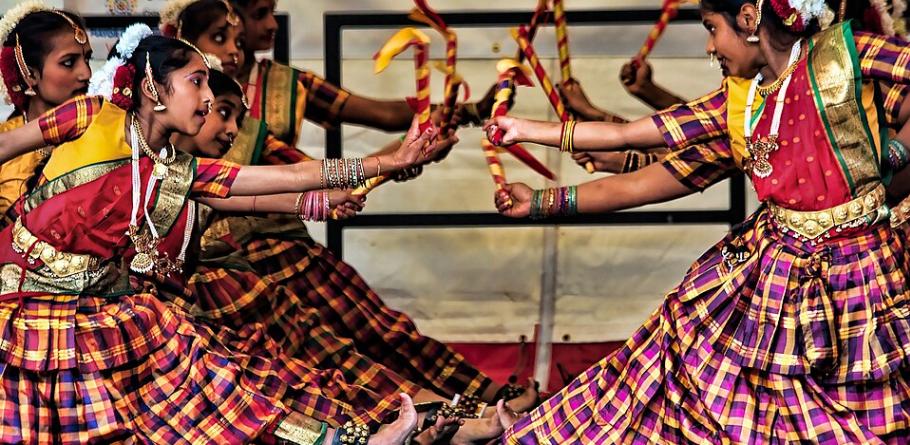
Girls dancing at the Celebrating Sanctuary Festival on London's South Bank in 2008. The festival celebrates the cultural diversty that migrants bring to the UK. Picture by Gary Knight.
Dance is a socially embedded, sensorially rich, and politically charged practice that transcends mere aesthetics. It can serve to tell stories and transmit knowledge within and across generations. It can also embody societal values, thereby challenging or reinforcing social hierarchies. Defined not solely by movement but also by its socially situated meanings, dance is an expressive system through which relationships, identities, and power are enacted and negotiated. This entry explores dance as both a localised embodied practice and as a globally circulating phenomenon. It begins by questioning universal definitions of dance before outlining key contributions from dance anthropology and ethno-choreology, specifically their focus on embodiment, research methods, and the limits of representation. Subsequent sections consider dance in relation to politics, and the impact of digital media in fostering global hybrid forms of dance. The final section examines staged performances and the role of UNESCO’s Convention for the Safeguarding of Intangible Cultural Heritage, which has further institutionalised dance by recognising it as a ‘living heritage’. Together, these sections illustrate that dance operates simultaneously as practice, symbol, and political artefact—what might be called its ‘multiple existences’—and explores why understanding these layers is essential across disciplines. As a dynamic and fluid practice, dance remains a vital subject of anthropological inquiry, revealing complex interactions between tradition, innovation, and socio-political power.
Introduction
Defining dance in anthropology is a challenge, since it does not always exist as a clear-cut category as such for the people we study. Speaking of ‘dance’ therefore risks profoundly misinterpreting the activities we try to analyse and the social contexts where they occur. For example, for the sixteenth century Mixtec people of Jamiltepec, in what is now Oaxaca, Mexico, no single term for ‘dance’ existed. Instead, the word yaa simultaneously referred to dance, games, and music, which were always performed together and not experienced as distinct or separate (Stanford 1966, 103). Likewise, in classical Greece, the term ‘ὄρχησις’ referred to the inseparable triad of music, song, and bodily movement—much as in many contemporary Greek folk dance practices. Again, ‘dance’ did not exist here as a meaningful stand-alone concept (Zografou 2003). The same point applies for the all-night yamɨn siria ceremony of Papua New Guinea’s Ambonwari people. Held in people’s private houses on celebratory occasions, it combines song and dance with storytelling and bodily decoration, elements that are closely connected to the natural environment and the spirit world. Yamɨn siria is not just a dance, but a holistic ritual that reflects an entire cosmology, reproduces the cultural memory of participants and their ancestors, provides young people with a chance to flirt, and can serve as an opportunity to settle old disputes (Telban 2017). In Arabic, several terms that describe movement and rhythmic expression also do not correspond precisely to the English notion of ‘dance’. Raqs (رَقص) broadly denotes Arabic dancing—often referred to colloquially as ‘belly dance’; dabke (دبكة) designates collective line dancing that embodies social cohesion; and samāʿ (سماع) refers to musical listening and rhythmic bodily movement within Sufi ritual (Rowe 2010, 11–3).
All that said, conceptual clarity can be useful so long as it speaks to the perspectives of the people we study. A fairly encompassing definition of dance considers it to be a practice composed of purposeful, often intentionally rhythmical, and socially patterned sequences of nonverbal body movement (Hanna 1979, 316). This movement is generally considered distinct from ordinary motor activities. It involves time, space, and effort, relies on both individual choice and social learning, and possesses inherent and aesthetic value. Specific criteria tend to determine what is appropriate in each context and what may distinguish the competency of dance practitioners as perceived by their society. Finally, such movement should be recognised as dance by its practitioners and—if an audience is present—by the audience members of the practitioner’s social group.
Understood in these terms, dance can be a powerful social instrument. Often much more than mere entertainment or artistic expression, it physically manifests identity, tradition, and a sense of belonging, while also reflecting and contesting social norms (Desmond 1997a; Kealiinohomoku 1970). Various academic disciplines, from psychology to performance studies, have explored dance from multiple angles, analysing its aesthetic, cognitive, and emotional dimensions. They have shown that politicians and media often harness dance as a symbol of national identity, and sometimes as a tool for cultural diplomacy. Anthropology brings a unique focus to the study of dance’s social implications and cultural contexts (Buckland 1999), in part because it tends to delve deeper into the meanings and power relations embedded in dance practices (Spencer 1985).
From the early twentieth century onward, dance has attracted the interest of influential anthropologists, including Edward Evan Evans-Pritchard (1928), Alfred Radcliffe-Brown (1922), Franz Boas (1927), Margaret Mead (1928) and Gregory Bateson (Mead and Bateson 1952). For these early writers, the documentation and analysis of Indigenous people’s dance was integral to understanding their social structures. As part of ritual, dance was primarily seen as contributing to social cohesion, essential for maintaining social bonds. Evans-Pritchard, for example, argued that that the gbere buda or ‘beer dance’ of the twentieth century Azande people, in what are now the Central African Republic, the Democratic Republic of the Congo, and South Sudan, allowed for moderate, discreet, and therefore harmless kinds of flirting and sexual play. Thereby, Evans-Pritchard argued, the dance protected the institutions of Azande marriage and the family (1928, 458). Early anthropological studies also emphasised the importance of dance for transmitting cultural knowledge. For example, according to Mead, dance interrupted the otherwise rigorous subordination of Samoan children during the early twentieth century to the social hierarchy they grew up in. Dance allowed them greater degrees of attention and freedom than they were habitually used to. It equally permitted the expression and cultivation of children’s individuality in ‘a genuine orgy of aggressive individualistic exhibitionism’ as Mead put it (1928, 118).
Early anthropological studies were equally fascinated by the ways in which ritual dance reflects and shapes people’s spiritual lives, serving as a powerful medium through which people express their cosmologies and influence spirits. During the late nineteenth century, for example, the Kwakiutl of North America used dance to attract life-giving spirits, to tame them, and to receive gifts of supernatural powers from them. As part of the ritual known as the ‘winter ceremonial’, Kwakiutl families came together and danced wearing masks that emulated and personated different spirits, tracing their family histories back to mythical times and supernatural events (Boas and Hunt 1897).
For many Indigenous peoples, ritual dance has remained central until today, as it remains part of ceremonies marking life events, seasonal transitions, and collective identity. The nomadic Wodaabe of West Africa, for example, engage in a series of dance and performance rituals throughout the year, one of which, called the yaake, comprises a beauty contest in which women chose the most beautiful male performer. The young men stand in a long line, facing the sunset, and dance by moving especially their feet and spinal column. Accentuated movements of the face highlight the whiteness of their eyes and teeth, all while being overlooked by Wodaabe women. It has been argued that in this case this dance not only expresses male pride or allows the men and women to flirt, but that it also distinguishes the Wodaabe from the more sedentary Fulani people who live in the same region. It renders the Wodaabe recognisably ‘exotic’ to the people of Niger, and to Westerners who are only superficially aware of their life circumstances. By internalising and cultivating their reputation of being ‘exotic’, Wodaabe dancing contributes to a sense of ‘cultural archaism’, which is but one of several elements of their collective survival strategies (Bovin in Hughes-Freeland & Crain 1998).
Anthropology’s early focus on the ritual contexts of dance laid the groundwork for more systematic engagements with dance, especially from the mid-twentieth century onwards. During this time, the subfield of dance anthropology (or the ‘anthropology of dance’ as it was called in the US) emerged, establishing a dialogue between dance studies and anthropology (Kurath 1960; Kealiinohomoku 1970). As part of a new comprehensive approach to dance, anthropologists and dance scholars synthesised methodologies and theoretical approaches, and began to study dance as a social phenomenon everywhere. They drew on examples from large and small-scale populations, as well as ‘modern’ and ‘non-modern’ groups.
In this way, they challenged prevailing Eurocentric views, which had, for example, considered ballet as the pinnacle of dance forms and as distinct from folk or ethnic dances. A ground-breaking study viewed ballet through the same anthropological lens as any other dance tradition (Kealiinohomoku 1970). It questioned the perception of ballet as a universal standard against which other dance forms were to be measured. The study recognised that ballet was conventionally celebrated for its aesthetic refinement and technical precision, having evolved from court entertainment to a professionalised art form: an ethnic dance of the West, rooted in the court cultures of Renaissance Italy and France. Political power, social hierarchies, and the spread of European colonialism had all shaped what ballet was and needed to be accounted for as ballet continues to express and reinforce the values and aesthetics of its cultural origins.
Examining ballet as an ethnic dance opened the door to a more egalitarian approach to dance studies overall, which values all dance traditions equally and appreciates their cultural significance (Kealiinohomoku 1970). Such studies and approaches suggested a more inclusive understanding of dance that recognises it in all its forms as ultimately culturally and ethnically rooted, whilst also arguing for the value of often-marginalised non-European dance traditions. Importantly, these authors called for more first-hand observation and participation in dance as part of fieldwork (Kurath 1960). Furthermore, discussions emerged that focused on how dance traditions change over time through incorporating elements from different trends that migrants carried into diverse new contexts. In line with the cultural relativism that marked the second half of the nineteenth century, anthropologists began to show that dance is often hybridised, constantly changing and blurring boundaries of traditions that had previously been considered fixed. For example, Latin American tango emerged from the fusion of African rhythms, European couple dances, and local criollo musical forms, later becoming reinterpreted through global circulation (Savigliano 1995, 10–5).
Anthropology of dance and ethno-choreology
The anthropology of dance has a close relative, called ‘ethno-choreology’ (sometimes called ‘dance ethnology’). While these fields of study often overlap, they have different starting points, methods, and theories (Kaeppler 1991, 13). Dance anthropology has a tendency to be more ‘interested in socially constructed movement systems, the activities that generate them, how and by whom they are judged, and how they can assist in understanding society’ (Kaeppler 2000, 120). A prime example is the ethnography on lakalaka performances, which are danced and sung throughout the islands of the Tonga archipelago in the South Pacific. Performed at royal weddings, royal birthday celebrations, and coronation ceremonies since the late nineteenth century, the lakalaka is not merely a form of aesthetic expression but also serves to enact and legitimise social hierarchy and political authority. It involves singing poetry which, together with choreographed movements, elevates the monarch and chiefs, linking royal and chiefly power within the broader Tongan cosmology (Kaeppler 2006, 40–1). These performances illustrate the social origins of movement systems, and their role for the broader organisation of society, as they help negotiate rank, genealogy, and political power. Rather than analysing the choreography in isolation, dance anthropology situates it within the Tongan system of social stratification, showing how dance both reflects and reinforces societal structures (Kaeppler 1993). In contrast, ethno-choreologists often focus more closely on dance content, while the cultural context serves primarily to illuminate the dance itself (Grau 1993, 21). For example, Andriy Nahachewsky (2011) examines the movement vocabulary, structural patterns, and stylistic variants of Ukrainian folk dances, drawing on ethnographic context chiefly to clarify regional distinctions and historical layering.
Dance anthropology and ethno-choreology also sometimes differ in how they think about the dancers’ bodies. Dance anthropology has come to question the idea of a natural or archetypal dancer’s body, foregrounding instead the body’s culturally and socially constructed aspects (Grau 1993, 21). Ethno-choreologists, on the other hand, tend to consider the dancer’s body more as a given; an instrument moving in time and space that is largely separate from the dancer’s mind or sociocultural ideas about it. This makes ethno-choreology particularly interesting for dancers and choreographers who are constantly attempting to improve upon existing forms of dance, as well as for folklorists, interested in the preservation of existing cultural practices.
In short, dance anthropologists are ‘not simply to understand dance in its cultural context, but rather to understand society through analysing movement systems’ (Grau 1993, 21), while ethno-choreologists study the dance itself and its changes over time with its cultural context more in the background (Kaeppler 1991, 16–7). Despite these differences, the fields have increasingly converged over time, particularly since the 1990s when both embraced a more holistic view of dance. Both disciplines now recognise that dance is not just interesting as a physical movement but also that it matters as a cultural text that can convey complex meanings and serve various social functions (Rakočević 2020). This shared perspective has led to greater interdisciplinary collaboration, enabling folklorists and cultural critics to employ similar methodologies and theories with the goal of exploring the multifaceted nature of dance.
A relatively recent study of folk dance in Romania, for example, demonstrates the value of combining dance anthropological and ethno-choreological approaches (Giurchescu 2001). Anca Giurchescu examines 45 years of cultural policy in socialist Romania to show how traditional dance, such as in the century-old Romanian Căluș ritual, has changed in connection to its socio-political context. Over time, Romanian traditional dance has turned from a ritual that shapes the daily lives of participants to a more restricted and staged form of folklore, mostly organised and watched rather than practiced. While it continues to be danced on important social events, such as weddings or family gatherings, it is now mostly passively consumed. As a form of folklore, traditional dance always runs the risk of being used for political ends, as in late-stage Romanian Communism, when song and dance were employed to conceal the country’s socio-political contradictions, obscuring diversity while highlighting a singular national narrative. According to the author, studying dance requires examining the philosophical, ideological, socio-political, economic, and cultural systems of a given society, as well as the internal structure of the dance itself. Only through this holistic approach can dance, its social context, and its practice be illuminated simultaneously (Giurchescu 2001, 109).
Dance as elusive and embodied practice
The ephemeral and elusive nature of dance renders participant observation particularly difficult. Dance only fully exists in the moment of performance, making it hard to capture and document. Its transience arises from several factors. Movement notation systems, while developed in order to record dance, are complex and require demanding training. Moreover, describing sound and movement (as well as speech and song in some cases) all at once can often be challenging. Simply filming dance and focusing on its visual aspects does not capture the whole experience as it ignores too many other sensorial dimensions of dance. Dancer’s experiences are deeply kinaesthetic (i.e. relating to their bodily awareness), combining the visual, tactile, and auditory (Bull 1997, 269). Such embodied experience is hard to put into words, so dancers’ verbal accounts of their practices often differ from their actual behaviour. All these issues raise the problem that dance experiences may be sensible to the performers without also being intelligible for others (Bull 1997, 269).
These methodological difficulties raise an ever-prevalent question for ethnographic researchers of dance: Should the ethnographer have practiced or be trained in dance, or is this not a requirement for a deep understanding of it? The people we study may think that dancing is essential if one wants to truly understand it. Members of professional dance companies, for example, have been shown to hold that experience in ballet is an asset to make sense of it (Wulff 1998). In fact, classical dancers are frequently of the opinion that ‘you have to do it in order to understand what it’s like’ (Wulff 1998, 8). Given that dance is a mostly non-verbal activity that requires a high degree of precision and proficiency, having some embodied experience of it allows for insights which are challenging to acquire by other means (Wulff 1998, 10-1). Thus, dance ethnographies often achieve a remarkable level of understanding by relying on the fieldworker's body as a means to attain cultural knowledge. The researcher's immersion in sonic events and movement—their awareness of and participation in sound and dance—induces bodily responses that render fieldwork as a profoundly visceral experience. Thereby, important questions can be raised and put into perspective, such as what the role of tacit knowledge in dance may be, how feelings of unity and community are created and altered by dance, or how dancers conceive of pain and endurance (c.f. Chrysagis and Karampampas 2017, 3, 10-2).
Physical participation in dance also shows how ‘movement combines felt bodily experience and the culturally based organisation of that experience into cognitive patterns’ (Sklar 2001, 4). It teaches us that ‘ways of moving are ways of thinking’ (Sklar 2001, 4). For example, for young members of the Greek goth scene in Athens in 2010, dance was an important part of their lives. Goth clubs and goth nights allowed them to link their daily style and ways of living, which often emphasised the fleeting nature of life and the futility of human striving, to dance. Several of them thus danced in ways that involved irony, self-irony, and sarcasm. On the dance floor they recited the lyrics of songs that expressed their disappointment with humanity, expressed anger at their own illness and mortality through stomping movements, or mocked traditional Greek dances in a refutation of Greek national values (Karampampas 2017).
Even when the researcher does not have prior dance experience, it is possible to learn dance in the field, as has been done for other somatic ethnographies that focused on boxing (Wacquant 2004) or Aikido (Kohn 2001). Particularly interesting are the times that the researcher will have to dance with their interlocutors. These moments allow the researcher to demonstrate whether and how they have embodied local dances and how precisely they understand the local movement idioms (Pateraki and Karampampas 2014, 156).
The deeply embodied nature of dance also highlights its role in shaping and experiencing gender, sexuality, and identity (Cowan 1990, Foster 1996). Dance practices often reflect and reinforce gender roles and expectations, but they can also provide spaces for exploring and contesting these norms (Allen 2022, 3–7 and 140–50). For example, Elizabeth Kirtsoglou (2004) has studied a group of middle-class women who form an all-female ‘company of friends’ (parea) near a Greek provincial town that the author calls ‘Kallipolis’. Once initiated to their ‘company’, the women spend time with and support one another, and they engage in same-sex relationships. One way in which they perform gender is through dance, notably the belly-dance tsifteteli, associated with femininity and desire, and the powerful, masculine dance called zeimbekiko. Dance and flirtation enable the women to create intimate relationships, which may be interpreted by people outside of their group as merely playful heterosexual friendships (Kirtsoglou 2004). Dancing thus allows them to negotiate, reveal, and conceal their identities, challenging and reconfiguring the meanings attached to their bodies within their specific cultural context.
The embodied nature of dance also lends itself to exploring how cultural and political meanings are represented, felt, and lived through the body. White competitive Latin dancers may use a fake tan to represent Latinness in the context of the predominantly white dancing culture and sport. In another context, practitioners of Javanese court dances are held to embody an element of national identity that is actively passed on to younger generations and made visible in performances for tourists (Kringelbach & Skinner 2012, 11). Thus, dance frequently turns out to be a site of negotiation where dancers can both conform to and resist social norms (Cowan 1990; Fraleigh 2004). It has, for example, been argued that the bodies of classical ballet dancers can be read as affirming a Western marginalisation of women’s bodies in general. According to sociologist Janet Wolff, ballet dancers preserve a ‘classical body’, emphasising boyish petiteness, clear lines, weightlessness and ethereal presence, ideals that stand in clear tension with most real feminine corporeality (Wolff 1997, 95). This tension is also revealed in roles for women, who in classical dance often depict ‘a strangely disembodied female’ (Wolff 1997, 95).
Deeply embodied activity, such as dance, also lends itself to the expression and transmission of embodied collective memory. Thus, dance is frequently part of spirit possessions among the Songhay people of Nigeria and Mali. The Songhay pantheon is divided into six spirit families, each of which represents a specific historical period. Some stand in for Muslim clerics, commemorating the fifteenth century institutionalisation of Islam in the area, while others are Hausa spirits that entered the Songhay pantheon in the early twentieth century as part of a large migration of Hausa-speaking people to Songhay territory. Spirit possession, which involves dance, thus partially enacts Songhay history, including the ravages of nature, such as when the choreography involved in a possession recounts the movement of spirits ‘from water to heaven and back to Earth’ (Stoller 1994, 642).
In sum, dance is not simply a sequence of movements but is also an embodied system of cultural meanings and knowledge. The meanings of dance are not always explicit, and may be tacit, intuitive, and difficult to articulate verbally. Researchers need to be aware that their own cultural background and experiences may shape their interpretations of dance. It is important for them to be reflexive, considering their own positionality and biases, and it is frequently an asset if, as part of dance research, they dance themselves.
Politics, resistance, and dancing beyond borders
Beyond its artistic or cultural expression, dance is a potent form of political discourse and resistance. The intricate relationship between dance and politics has been extensively analysed, revealing how dance movements and performances can reflect, contest, and sometimes transform political realities (Shay 2002).
Dance frequently intersects with political power in the realm of national identity and statecraft. Dances are often promoted and institutionalised through state-sponsored performances, festivals, and education programs. They may serve to foster national unity, constitute emblematic representations of a nation’s cultural heritage that justifies national sovereignty, or simply project power both internally and on the international stage (Reed 1998). For example, in constructing and legitimising national identity in the modern Greek state, officially established in 1832, ancient Greek statues and monuments were used to associate the state with ancient Greek glory. In this process, folk traditions such as dances and songs were used to bridge the substantive gap between ancient and modern Greek identity, including serving as official ‘proofs’ of the ‘cultural continuity’ between the two (Karampampas 2021, 655). Until today, the so-called ‘Greek traditional dances’ are part of the country’s primary and secondary education curriculum, aiming to demonstrate the coherence of Greek populations by teaching a selection of dances that is meant to represent all the country’s regions (Karampampas 2021, 655). Importantly, this curriculum has excluded dances from the unrecognised Slavic-speaking Greek minority, marginalising some kinds of dance as it foregrounds others (Pateraki 2024; see also Manos 2003 on the minority politics of dance). In addition, some previously Greek dances are today danced beyond national borders and may be called ‘Albanian’ or ‘Turkish’, due to the shared past of these countries during the Ottoman Empire. Indeed, ‘Greek dances’ to music that shares melodies with that of the Cappadocia region of what is now Turkey are performed as far as in the city of Xi’an (西安), the capital of the Chinese province of Shaanxi where the Muslim minority of Hui people (回族) dances them (personal observation).
In addition to creating national identity, Jane Cowan (1990) provides us with an example of how dance can stand in for European modernity. As part of studying dance in the Northern Greek town of Sohos in the early 1980s, Cowan noticed that formal ‘evening-dances’ (horoesperidha) were regularly organised on the weekends by local civic associations such as political parties or business associations. Rather than celebrating kinship, belonging, or church affiliation, these dance events were meant to promote civic solidarity and the common good, while also fostering the wealth, reputation, and political standing of the associations that sponsored them (Cowan 1990, 134–70). To achieve these goals, the usual opportunities for competitive male dance and folklore were foreclosed, and European symbols and practices were adopted instead, including dancing ‘European dances’ like the waltz, the foxtrot, and the tango, and wearing modern apparel rather than traditional clothing. These evening-dances linked the civic associations to the West, which had long politically and culturally dominated Greece, and stood in for modernity.
National and international understandings of dance can often greatly influence one another. As mentioned above, tango, for example, originally developed in the late nineteenth century around the Río de la Plata that separates Argentina and Uruguay. It fused African rhythms, recreated by former slaves, with music of Spanish descendants born in the Americas (criollos), and with European influences brought by mostly Spanish and Italian migrants. As such, it can be seen as a dance of exiles (Savigliano 1995, xiv). However, tango soon developed into a system of seemingly ‘exotic’ Argentinian identity, considered wild, untamed, and passionate by the colonial and imperial powers of Argentina and Uruguay. As part of a global ‘political economy of passion’ that included tango records, handbooks, films, and fashion, foreigners appropriated the dance throughout the first half of the twentieth century in Paris, London, and New York, and all the way to Japan. Tango underwent an even more widespread revival in the second half of the twentieth century. The fact that it also became Argentina’s national dance can only be made sense of when considering the interplay between Europe’s former Latin American colonies and ongoing Western imperialism. Western countries were eager to consume exoticised forms of dance that ultimately legitimated their own perceived superiority. Once consumed abroad, the exoticised dance could be re-appropriated by national elites as an appropriate marker of national identity (Savigliano 1995, 138).
However, dance can also serve as a site of resistance against colonial or oppressive regimes, providing a means through which marginalised communities assert their own identity and sovereignty. The Irish dance revival in the late nineteenth and early twentieth centuries, for instance, was closely tied to broader nationalist movements seeking to affirm Irish identity in the face of British rule (O’Connor 2013; Wulff 2007). The Gaelic League and other cultural organisations promoted step dancing and céilí dancing as emblematic expressions of an authentically Irish way of life, in contrast to what they saw as British cultural dominance. Standardised competitions, codified techniques, and public performances all became tools for mobilising dance as a marker of national unity and cultural distinctiveness.
Similarly, dance has played a key role in the expression of Palestinian national identity, serving as a form of cultural resistance against European colonial imperialism as well as Israeli occupation and Islamic reform movements (Rowe 2010). Nicholas Rowe, who lived in Ramallah between 2000 and 2008 and worked with local dance groups in refugee camps across the West Bank and Gaza Strip, raises the question of whether dance can be represented without highlighting the extreme political circumstances in which it takes place. He shows that Palestinian dance productions become impossible as choreographers and their family members are killed, curfews and roadblocks make movement impossible, and dance venues are vandalised and destroyed (Rowe 2010, 189). Yet even under these difficult circumstances, dance may continue, not least to express individual and collective trauma (Rowe 2010). In a similar vein, the resurgence of Indigenous dances in the Americas is not only a revival of cultural practices but also a statement of resistance against colonial erasure and a declaration of sovereignty (Prichard 2022).
Of course, the political affordances of dance go beyond traditional party or state politics. An example of this is the critical role that dance plays in creating a queer Latino/a public in the United States. During the late 1990s and early 2000s, as the US Latino/a population quickly gained public visibility, dance (along with other forms of performance) was crucial to enable queer Latinos/as to equally claim spaces that allowed them to live publicly. Their increase in social rights was partially enabled by queer Latino/a cultural production, which had in the 1990s permeated the mainstream American queer culture in the form of Latin rhythms and choreographies (Rivera-Servera 2012, 15). Queer Latino/as’ ability to dance eloquently to Latin rhythms helped shift the power dynamics of the dance floor of the clubs they frequented. Their dance skills can thus be understood as ‘choreographies of resistance’—as embodied practices through which minoritarian subjects claim space in social and cultural realms, such as the dance floor (Rivera-Servera 2012, 43). Studying queer Latino/a identity through dance raises the question of whether Latinidad should be thought of as a programmatic political identity in the first place, or rather ‘as a performative modality’ that establishes Latino/a cultural practice (Rivera-Servera 2012, 20).
Importantly, the role of dance in enabling oppressions or resistence is not always clear cut. Thus, dance has been a form of resistance for the Italian mafia, in mafia-patronised religious celebrations of southern Italy. These celebrations include dances on the towns’ main squares, in which prominent members of the mafia dance with local politicians and both parties engage in a symbolic fight with imaginary knives and sticks (Pipyrou 2016, 175–8). These dances imply mutual political recognition, but they also enable members of the mafia to challenge regional state hegemony. They come with ambiguous real-life consequences, as local politicians may participate as they are trying to gain local votes, while members of the mafia do the same to gain recognition and status.
The fact that dance constitutes a form of ‘embodied resistance’ distinguishes it from other forms of political activism. Dance allows individuals and communities to express dissent and critique socio-political conditions in a way that words alone cannot (Fraleigh 2004). For instance, during the apartheid era in South Africa, the gumboot dance, which includes groups of performers stomping and tapping on their rubber boots, evolved as a form of resistance among mine workers. It was a covert way to communicate and to express grievances under the guise of entertainment (Welsh-Asante 1993). Similar roots entangled with a complex and contested history can also be found in capoeira, a hybrid between a dance, a martial art, and a game. It was likely developed in Africa by enslaved people who sought to practise self-defence under the guise of dance before being transported to Brazil. Evidence shows that it has been practised in Brazil since at least 1900 by the male African-Brazilian urban underclass. For some time, the government criminalised capoeira, and practitioners were persecuted until it was legalised in 1937. After 1975, it spread to the US and Europe, and soon after to the rest of the world (Delamont and Stephens 2008, 58). Thus, what began as a form of ‘embodied resistance’ became a global practice that celebrates the hybridisation of Portuguese and African-Brazilian music, dance, and bravery. On 26 November 2014, UNESCO recognised capoeira as Intangible Cultural Heritage.
The global spread of dance forms via media and migration has further complicated the dance-politics nexus, introducing issues of cultural appropriation, global inequality, and transnational identities. Street dance styles like breakdancing have been adopted by young persons across the world. This may come as a way of expressing resistance against societal norms and injustices (Koutsougera 2023; Marsh and Campbell 2020). At the same time, the global popularity of dances raises questions about cultural ownership, authenticity, and the commercialisation of cultural expressions (Ana 2017). Cuban rumba, for example, has been strategically packaged for international tourism, where performers are expected to embody ‘authentic’ Afro-Cuban identity in ways that cater to visitor expectations; yet rumberos themselves often receive minimal benefits from this commodification, and many view the state-driven ‘heritagization’ of rumba with ambivalence (Ana 2017, 163–7, 173–6, 181–3).
The global spread of dance forms also raises questions regarding their hybridisation, which is often presented as a result of globalisation (Duffy 2005). Hybrid dances emerge when elements from different dance traditions combine to create new forms, reflecting the complex interactions and exchanges facilitated by global flows of people and media. One example is the Tribal Fusion dance, in which North African and Arabic dance (colloquially known as ‘belly dance’) practitioners blend modern electronica and other various styles in creative and largely unbound ways. Dancers in this style thereby mostly do not reference the modern Middle East. As a result, their dance style may be derided by purists as derivative and degenerate compared to seemingly more ‘authentic’ forms of belly dance. At the same time, the freedom of Tribal Fusion enables the dancers to eschew accusations of cultural appropriation and to bring their very own styles to the transnational dance scene, drawing on movements from tango, flamenco, jazz, and modern dance, among others (Scheelar 2013; Sellers-Young 2016).
The digital age has further accelerated the global spread and transformation of dance practices. Social media platforms and video-sharing sites enable the rapid dissemination of dance videos, influencing global dance trends and fostering a sense of global community among dancers and enthusiasts. This has also allowed new dance styles to be created, such as industrial dance, a highly stylised goth-style dance with a well-defined repertoire of movements that is practised in similar ways in different goth scenes around the world. Its creation and development, however, took place almost entirely online. Goth YouTubers from different parts of the world began uploading videos of themselves dancing to industrial music, often inspired by cyber and rave aesthetics. These videos sparked discussion in the comment sections and across online forums, where users debated what counted as industrial dance. Through these public exchanges—offering feedback, critique, and praise—a shared set of movements and aesthetics gradually emerged. Over time, these digital interactions informally established and defined industrial dance, both morphologically and conceptually, without the need for a central authority or institutional framing (Karampampas 2016, 139–46).
A compelling example of rapid global circulation in digital times is Japanese Butoh, developed in the second half of the twentieth century and marked by grotesque imagery, playful experimentation, and slow, hyper-controlled motion. Since the 1980s, Butoh groups have emerged around the world, with many non-Japanese practitioners becoming recognised artists and teachers who establish their own schools and often develop approaches that diverge from the original lineages (Calamoneri 2008, 36–7; Candelario 2019, 245–52; van Hensbergen 2019, 276–84). The global and increasingly digital dissemination of Butoh enables unprecedented participation and innovation, while also raising questions about authorship, ownership, and the ethics of cross-cultural transmission (Garnica 2019, 325–36).
Dance as intangible cultural heritage
Dancing, particularly when it is staged, can often be read as a performance of folklore, i.e. of a traditional custom that links to the beliefs or values of a specific group. It can thus stand in tight connection with broader cultural narratives, identities, and histories. This ‘second existence’ of dance, beyond its initial performance context, matters when dance is reinterpreted, adapted, or incorporated into new spatial, temporal, or cultural settings. Keeping the folkloristic aspects of dance in mind allows anthropologists to explore the dynamic processes through which traditions are transmitted, transformed, and reimagined in response to changing cultural landscapes (Nahachewsky 2001). The second existence of dance may have a parallel life with the ‘first’, i.e. with the folk-dance performances which continue to take place in their initial social context. At other times, the initial social context may have changed, or there may be discontinuity in the transmission of knowledge, and in some cases, the second existence of dance replaces the first. The second existence of dance also encompasses how dance traditions are taught, learned, and practised beyond their original contexts. Dance workshops, festivals, and educational programs serve as important spaces for the transmission and adaptation of dance traditions, contributing to the ongoing evolution of dance forms and the formation of transnational dance communities (Karampampas 2021, 660–1; Sklar 2001).
The staging of dance can thus be seen as a site of cultural production where meanings are negotiated between performers and audiences. When dances are staged, they are often adapted or recontextualised to fit new settings, engaging with audiences unfamiliar with the original cultural context. Staging can thus be seen as a form of cultural translation, where the inherent meanings and aesthetics of a dance are interpreted and potentially transformed (Shay 2016). Moreover, the folkloristic aspects of dance on stage raise questions about its authenticity and about the safeguarding of intangible cultural heritage. Debates about authenticity highlight the tension between the desire to preserve cultural heritage and the need for artistic innovation and cultural exchange (Bendix 1997; Theodossopoulos 2013).
For example, in 2003 the UNESCO Convention for the Safeguarding of Intangible Cultural Heritage (ICH) aimed, among other things, to rethink what folklore, now referred to as ‘intangible heritage’, may be. It inaugurated the important shift from trying to record and preserve disappearing traditions to promoting their ongoing transmission. This was to be achieved by supporting both practitioners and the conditions necessary for their practices to continue (Kirshenblatt-Gimblett 2014, 53). While this marks a shift from older folkloristic approaches, the Convention still relies on established methods like listing, mapping, and recording (Kuutma 2012; Tauschek 2011). Notions of authenticity thus persist—albeit in redefined terms—and continue to shape public perceptions of cultural value (Bendix 2018, 6; Bortolotto 2020).
Transforming a tradition into ICH involves a process of ‘heritagisation’. This process can be deeply self-referential, as constructing heritage can itself be part of the cultural and social processes that end up constituting heritage (Smith 2006, 13). For example, when a community prepares a dance for inclusion in an ICH inventory—by defining what counts as ‘authentic’, formalising choreography, or crafting heritage narratives—these acts of preparation reshape the tradition and feed back into how it is understood. At the same time, the dance itself becomes a policy object, especially when viewed through the lens of Intangible Cultural Heritage, where safeguarding frameworks transform lived practices into administratively managed ‘heritage’ (Smith 2006, 13; Tauschek 2011). ICH may therefore be seen not merely as preserved tradition, but as a metacultural production (Tauschek 2011), a policy-oriented reimagining of tradition focused on safeguarding, transmission, and empowerment. Following this logic, ICH could be seen as a third existence (Karampampas forthcoming) of dance: no longer just a performance or culturally relevant social activity, but a policy artefact focused on cultural continuity. Through this lens, dance is framed not as a static, authentic relic, but as a living tradition that carries community values, identities, and histories. This third existence resists overly static and folkloristic views of dance and opens new directions for anthropological inquiry.
Conclusion
The study of dance offers profound insights into the human condition. It allows us to understand and rethink social dynamics and structures, as well as individual and collective identities. Dance is not merely an art form but is also a rich cultural practice that informs and is informed by the contexts in which it occurs. Its analysis reveals the many, often highly nuanced ways in which communities express themselves, negotiate social norms, and maintain traditions, making it an endlessly fascinating subject for future study. As societies continue to change, the relevance of studying dance remains undiminished. It offers a unique vantage point from which to observe the ongoing interplay between tradition and innovation, providing a mirror in which we can view the continuous reshaping of identities in response to global influences and local practices.
The ephemeral nature of dance, with its ability to adapt and morph into new forms while retaining links to the past, makes it an ideal subject for exploring broader questions of continuity and change in contemporary societies. At the same time, the rise of the internet and the turbocharged hybridisation of dance make it more exciting than ever. As a form of embodied, non-verbal communication that transcends social and linguistic barriers, dance is likely to remain crucial to understand the human condition in an increasingly interconnected world.
Acknowledgements
I would like to thank the three anonymous reviewers for their thoughtful and constructive feedback. I am especially grateful to the editors, Hanna Nieber and Felix Stein, whose exceptional patience and valuable suggestions have shaped this entry and supported its successful completion.
References
Allen, Jafari S. 2022. There’s a disco ball between us: A theory of Black gay life. Durham, N.C.: Duke University Press.
Ana, Ruxandra. 2017. “Rumba: Heritage, tourism and the ‘authentic’ Afro-Cuban experience.” In Collaborative intimacies in music and dance: Anthropologies of sound and movement, edited by Evangelos Chrysagis & Panas Karampampas, 163–86. New York: Berghahn Books.
Bendix, Regina F. 1997. In search of authenticity: The formation of folklore studies. Madison: University of Wisconsin Press.
––––––– 2018. Culture and value: Tourism, heritage, and property. Bloomington: Indiana University Press.
Boas, Franz. 1927. Primitive art. Oslo: Aschehoug and Cambridge.
Bortolotto, Chiara. 2020. “Le patrimoine immatériel et le tabou de l’authenticité : de la pérennisation à la durabilité." In Le patrimoine culturel immatériel au seuil des sciences sociales, edited by Julia Csergo, Christian Hottin and Pierre Schmit, 218–35. Paris: Éditions de la Maison des sciences de l’homme.
Bovin, Mette. (1998) 2005. "Nomadic performance - pecuilar culture? 'Exotic' ethnic performances of WoDaaBe nomads of Niger." In Recasting ritual: Performance, media, identity, edited by Felicia Hughes-Freeland and Mary M. Crain, 93-112. London: Routledge.
Buckland, Theresa J., ed. 1999. Dance in the field: Theory, methods and issues in dance ethnography. Palgrave Macmillan.
Bull, Cynthia Jean Cohen. 1997. "Sense, meaning, and perception in three dance cultures." In Meaning in motion: New cultural studies reader, edited by Jane Desmond, 269–88. Durham, N.C.: Duke University Press.
Calamoneri, Theresa. 2008. "Going native? Ethics and American cultural appropriation of Butoh dance." Dance Research Journal 40, no. 2: 36–49.
Chrysagis, Evangelos & Panas Karampampas 2017. "Introduction: Collaborative intimacies." In Collaborative intimacies in music and dance: Anthropologies of sound and movement, edited by Evangelos Chrysagis and Panas Karampampas, 1–24. New York: Berghahn Books.
Cowan, Jane K. 1990. Dance and the body politic in Northern Greece. Princeton: Princeton University Press.
Delamont, Sara and Neil Stephens 2008. "Up on the roof: The embodied habitus of diasporic capoeira." Cultural Sociology 2: 57–74.
Desmond, Jane, ed. 1997a. Meaning in motion: New cultural studies reader. Durham, N.C.: Duke University Press.
––––––– 1997b. "Embodying difference: Issues in dance and cultural studies." In Meaning in motion: New cultural studies reader, edited by Jane Desmond, 29-54. London: Routledge.
Duffy, Michelle. 2005. "Performing identity within a multicultural framework." Social & Cultural Geography 6: 677–92.
Evans-Pritchard, Edward Evan. 1928. "The dance." Africa 1: 446–62.
Foster, Susan L., ed. 1996. Corporealities: Dancing knowledge, culture and power. London: Routledge.
Fraleigh, Sondra Horton. 1987. Dance and the lived body: A descriptive aesthetics. Pittsburgh: University of Pittsburgh Press.
––––––– 2004. Dancing identity: Metaphysics in motion. Pittsburgh: University of Pittsburgh Press.
Garnica, Ximena. 2019. "LEIMAY, CAVE, and the New York Butoh Festival.” In The Routledge companion to Butoh performance, edited by Bruce Baird and Rosemary Candelario, 325–36. London: Routledge.
Giurchescu, Anca. 2001. “The power of dance and its social and political uses.” Yearbook for Traditional Music 33: 109–21. https://doi.org/10.2307/1519635.
Grau, Andrée. 1993. "John Blacking and the development of dance anthropology in the United Kingdom." Dance Research Journal 25: 21–31.
Hanna, Judith Lynne. 1979. "Movements towards understanding humans through the anthropological study of dance." Current Anthropology 20: 313–39.
––––––– 1987. To dance is human: A theory of nonverbal communication. Chicago: University of Chicago Press.
van Hensbergen, Rosa. 2019. “German Butoh since the Late 1980s.” In The Routledge companion to Butoh performance, edited by Bruce Baird and Rosemary Candelario, 276–84. London: Routledge.
Kaeppler, Adrienne. L. 1991. "American approaches to the study of dance." Yearbook for Traditional Music 23: 11–21.
––––––– 2000. "Dance ethnology and the anthropology of dance." Dance Research Journal 32: 116–25.
––––––– 2006. "Dances and dancing in Tonga: Anthropological and historical discourses." In Dancing from past to present: Nation, culture, identities, edited by Theresa Jill Buckland, 25–51. Madison: The University of Wisconsin Press.
Karampampas, Panas. "Dancing into darkness: Cosmopolitanism and ‘peripherality’ in the Greek goth scene." PhD thesis, University of St Andrews, 2016.
––––––– 2017. "Performing irony on the dance floor: The many faces of goth irony in the Athenian goth scene." In Collaborative intimacies in music and dance: Anthropologies of sound and movement, edited by Evangelos Chrysagis and Panas Karampampas, 209–33. New York: Berghahn Books.
––––––– 2020. "Partying at times of crises and pandemics: Solidarity, resilience and coping with the measures against COVID-19." Social Anthropology 28: 292–3.
––––––– 2021. "(Re)inventing intangible cultural heritage through the market in Greece." International Journal of Heritage Studies 27: 654–67.
–––––––, n.d. "Intangible Cultural Heritage: 'First,' 'second,' or perhaps multiple 'existences' of tradition."
Kealiinohomoku, Joann. 1970. "An anthropologist looks at ballet as a form of ethnic dance." Impulse: Extensions of Dance 20: 24-33.
Kirshenblatt-Gimblett, Barbara. 2014. "Intangible heritage as metacultural production." Museum International 6: 163–74.
Kirtsoglou, Elisabeth. 2004. For the love of women: Gender, identity and same-sex relations in a Greek provincial town. London: Routledge.
Kohn, Tamara. 2001. "Don’t talk – blend: ideas about body and communication in aikido practise." In An anthropology of indirect communication, edited by Joy Hendry and Conrad William Watson, 175–90. London: Routledge. https://doi.org/10.4324/9780203428573-17
Koutsougera, Natalia. 2023. "'Out in the streets': Hip-hop narratives in contemporary Greece." Meridians 22: 204–28.
Kringelbach, Hélène Neveu and Jonathan Skinner. 2012. "Introduction: The movement of dancing cultures." In Dancing cultures: Globalization, tourism and identity in the anthropology of dance, edited by Hélène Neveu Kringelbach and Jonathan Skinner, 1–25. New York: Berghahn.
Kuutma, Kristin. 2012. "Between arbitration and engineering: Concepts and contingencies in the shaping of heritage regimes." In Heritage regimes and the state (eds) Regina F. Bendix, Aditya Eggert and Arnika Peselmann, 21–36. Göttingen: Universitätsverlag Göttingen.
Manos, Ioannis. 2003. "‘To dance or not to dance’: Dancing dilemmas in a border region in northern Greece." Focaal - European Journal of Anthropology 41: 21–32.
Marsh, Charity and Mark V. Campbell (eds). 2020. We still here: Hip hop north of the 49th Parallel. Montreal: McGill-Queen’s University Press.
Mead, Margaret. 1928. Coming of age in Samoa: A psychological study of primitive youth for western civilisation. New York: William Morrow and Co.
Mead, Margaret and Gregory Bateson. 1952. Trance and dance in Bali. New York: New York University Film Library.
Nahachewsky, Andriy. 2001. "Once again: On the concept of ‘second existence folk dance.’" Yearbook for Traditional Music 33: 17–28.
–––––––. 2011. Ukrainian dance: A cross-cultural approach. Jefferson: McFarland.
O’Connor, Barbara. 2013. The Irish dancing: Cultural politics and identities, 1900-2000. Cork: Cork University Press.
Pateraki, Mimina. 2024. Επιλεκτικές εφαρμογές παγκοσμίων πολιτιστικών πολιτικών και ανθεκτικότητα. Αποσπασματικές ενέργειες στα χρόνια της λιτότητας στο Λεωνίδιο Τσακωνιάς (Πελοπόννησος, Ελλάδα). In Άυλη Πολιτιστική Κληρονομιά σε καιρούς οικονομικής κρίσης: Ένταξή στην αγορά και ανθεκτικότητα. ("Selective implementations of global cultural politics and resilience [fragmented act]." In Intangible cultural heritage in times of economic crisis: Marketisation and resilience, edited by Panas Karampampas, 92–104. Athens: The Hellenic Ministry of Culture and Sports Press.)
Pateraki, Mimina and Panas Karampampas 2014. "Methodological insights in dance anthropology: Embodying identities in dance celebrations in the context of Metamorphosis of Sotiros in Sotira, South Albania." In Balkan border crossings: Third annual of the Konitsa Summer School, edited by Vassilis Nitsiakos, Ioannis Manos, Georgios Agelopoulos, Aliki Angelidou, and Vassilis Dalkavoukis, 149–74. Berlin: LIT.
Pipyrou, Stavroula. 2016. The Grecanici of Southern Italy: Governance, violence, and minority politics. Philadelphia: University of Pennsylvania Press.
Prichard, Robin. 2022. "Native American dance and engaged resistance." In Milestones in dance in the USA, edited by Elizabeth McPherson, 3–26. London: Routledge.
Radcliffe-Brown, Alfred R. 1922. The Andaman Islanders. Cambridge: Cambridge University Press.
Rakočević, Selena. 2020. "Political complexities of ethnochoreological research: The facets of scholarly work on dance in the countries of Former Yugoslavia. Acta Ethnographica Hungarica 65, no. 1: 13–26.
Reed, Susan A. 1998. "The politics and poetics of dance." Annual Review of Anthropology 27: 503–32.
––––––– 2010. Dance and the nation: Performance, ritual, and politics in Sri Lanka. Madison: The University of Wisconsin Press.
Rivera-Servera, Ramón H. 2012. Performing queer Latinidad : Dance, sexuality, politics. Ann Arbor: University of Michigan Press.
Rowe, Nicholas. 2010. Raising dust: A cultural history of dance in Palestine. London: I.B. Tauris.
Savigliano, Marta E. 1995. Tango and the political economy of passion. New York: Routledge.
Scheelar, Catherine Mary. 2013. "The use of nostalgia in tribal fusion dance." In Belly dance around the world: New communities, performance and identity (eds) Caitlin McDonald & Barbara Sellers-Young, 121–37. Jefferson, N.C.: McFarland & Company.
Sellers-Young, Barbara. 2016. Belly dance, pilgrimage and identity. London: Palgrave Macmillan.
Shay, Anthony. 2002. Choreographic politics: State folk dance companies, representation and power. Middletown: Wesleyan University Press.
––––––– 2016. "The spectacularization of Soviet/Russian folk dance: Igor Moiseyev and the invented tradition of staged folk dance." In Oxford handbook of dance and ethnicity, edited by Anthony Shay and Barbara Sellers-Young, 236–55. Oxford: Oxford University Press.
Sklar, Deidre. 2001. Dancing with the virgin: Body and faith in the Fiesta of Tortugas, New Mexico. Berkeley: University of California Press.
Smith, Laurajane. 2006. Uses of heritage. London: Routledge.
Spencer, Paul, ed. 1985. Society and the dance: The social anthropology of process and performance. Cambridge: Cambridge University Press.
St John, Graham, ed. 2004. Rave culture and religion. London: Routledge.
Stanford, Thomas. 1966. "A linguistic analysis of music and dance terms from three sixteenth-century dictionaries of Mexican Indian languages." Anuario 2: 101–59.
Stoller, Paul. 1994. “Embodying colonial memories.” American Anthropologist 96, no. 3: 634–48.
Tauschek, Markus. 2011. "Reflections on the metacultural nature of intangible cultural heritage." Journal of Ethnology and Folkloristics 5: 49–64.
Telban, Borut. 2017. "The intoxicating intimacy of drum strokes, sung verses and dancing steps in the all-night ceremonies of Ambonwari (Papua New Guinea)." In Collaborative intimacies in music and dance: Anthropologies of sound and movement, edited by Evangelos Chrysagis and Panas Karampampas, 234–57. New York: Berghahn Books.
Theodossopoulos, Dimitrios. 2013. "Laying claim to authenticity: Five anthropological dilemmas." Anthropological Quarterly 86: 337–60.
Welsh-Asante, Kariamu. 1993. The African aesthetic: Keeper of the traditions. Westport, CT: Greenwood Press.
Wulff, Helena. 1998. Ballet across borders: Career and culture in the world of dancers. Oxford: Berg.
–––––––. 2007. Dancing at the crossroads: Memory and mobility in Ireland. Oxford: Berghahn Books.
Zografou, Magda. 2003. Ο Χορός στην Ελληνική Παράδοση (Dance in Greek tradition). Athens: Art Work.
Note on contributor
Panas Karampampas, PhD (St Andrews) is a Social Anthropologist at Durham University. He currently works on Intangible Cultural Heritage policies, bureaucracy, and global governance. His doctoral research focussed on the goth scene, digital anthropology, dance, cosmopolitanism, peripherality, and globalisation. He serves as an elected member of the Executive Board of the European Association of Social Anthropologists (2025–2027).
panas.karampampas@easaonline.org / ORCID: 0000-0001-8712-9445